High Tensile Bolts
Specifications
Mumbai · India
What Does “High Tensile Bolts Specifications” Mean
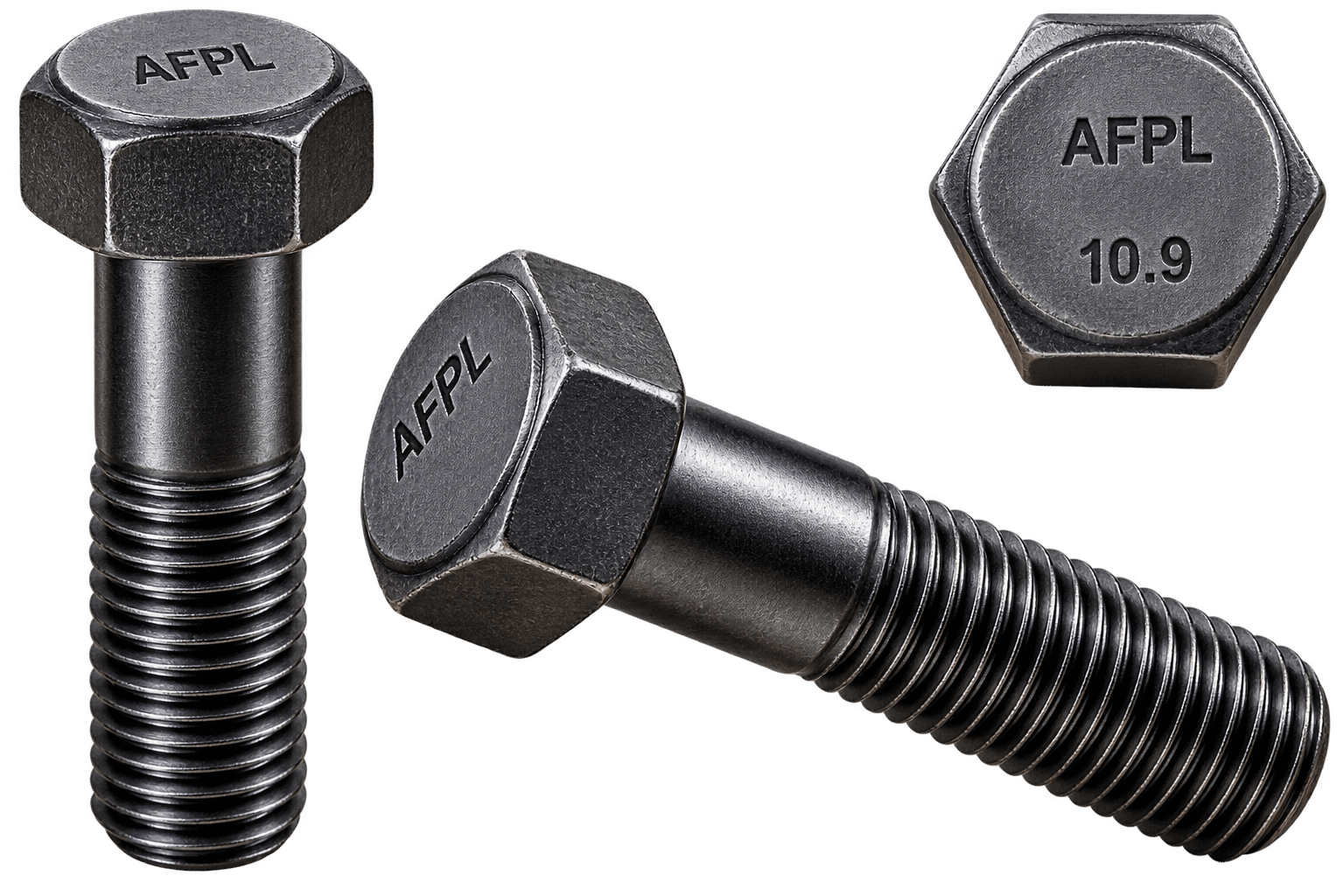
“High tensile” is shorthand for a bolt’s ability to withstand tensile load before yielding or fracturing — and internationally, that capability is formalized under ISO 898-1 as a two-part property class number stamped or forged directly onto the bolt head. The first number, multiplied by 100, gives the approximate minimum tensile strength in MPa. The second number, divided by 10, gives the ratio of yield strength to tensile strength. A class 8.8 bolt therefore has a minimum tensile strength around 800 MPa and a yield-to-tensile ratio of 0.8 — and that marking on the head is how the class is verified, not the bolt’s appearance or diameter.
Higher property class is not automatically the better choice. Class 12.9 bolts are stronger but also harder and more brittle, and are more susceptible to hydrogen embrittlement during plating — which is why many structural codes explicitly restrict or prohibit class 12.9 in certain structural steel connections, reserving it instead for machinery and automotive applications where the loading and environment are well controlled. Class 8.8 remains the most common general structural grade, while class 10.9 sits as the higher-strength option most often specified for structural bolting where 8.8 doesn’t provide enough margin.
Akbar Fasteners Pvt. Ltd. exports to over 50 countries, and our high tensile bolt range is manufactured and marked to ISO 898-1 with full mill test documentation, alongside equivalent high-strength ASTM grades for buyers working to American specifications.
Where Property Class Genuinely Matters
Verified Load-Carrying Capacity
Every property class carries a guaranteed minimum tensile and yield strength — critical for structural calculations that can’t tolerate a weaker-than-marked fastener.
Traceable Head Marking
Forged property class marking on every bolt head allows on-site verification against the drawing, without relying on paperwork alone.
Embrittlement Awareness
We flag hydrogen embrittlement risk on high-class plated fasteners rather than treating class 12.9 as a default upgrade over 10.9.
Correct Class for the Code
We help confirm the property class actually permitted for your structural code or application before quoting the wrong strength grade.
Class 8.8 vs 10.9 vs 12.9
Property class selection isn’t just “pick the strongest number” — higher classes trade toughness and embrittlement resistance for raw strength, and many structural codes explicitly restrict which classes are permitted in which joint type. The comparison below is the one we walk through with buyers before quoting, so the class matches both the load and the code.
| Property | Class 8.8 | Class 10.9 | Class 12.9 |
|---|---|---|---|
| Minimum Tensile Strength | 800 MPa | 1040 MPa | 1220 MPa |
| Minimum Yield Strength | 640 MPa | 940 MPa | 1100 MPa |
| Yield-to-Tensile Ratio | 0.8 | 0.9 | 0.9 |
| Typical Hardness (HV) | 255–319 | 320–380 | 385–435 |
| Embrittlement Risk (if plated) | Low | Moderate | Higher — often restricted |
| Best Suited For | General structural & mechanical bolting | Higher-load structural & flange bolting | Automotive & machinery, controlled environments |
High Tensile Property Class Range
Class 8.8 Bolts
The most common general structural and mechanical high tensile bolt, 800 MPa minimum tensile strength.
Class 10.9 Bolts
Higher-load structural bolting where class 8.8 doesn’t provide enough margin, 1040 MPa minimum tensile.
Class 12.9 Bolts
Maximum standard strength class for automotive and machinery, 1220 MPa minimum tensile strength.
A193 B7 / A320 L7 Studs
American high-strength stud bolt grades for pressure vessel and flanged piping applications.
High Tensile Bolt Technical Overview
How Property Class Is Identified
- Marking Format Two numbers, e.g. 8.8
- First Number ×100 Approx. tensile strength (MPa)
- Second Number ÷10 Yield-to-tensile ratio
- Marking Method Forged, not printed
- Manufacturer ID Also marked per ISO 898-1
Typical Steel Grades by Class
- Class 8.8 Medium carbon steel, Q&T
- Class 10.9 Alloy steel, Q&T
- Class 12.9 Alloy steel, higher hardenability
- Coating Options Zinc, HDG, Xylan on request
- Testing MTC / NABL on request
Available Dimensions
- Metric Diameter M6 – M64
- Imperial Diameter 1/4″ – 4″
- Length Custom to drawing
- Thread Type UNC / UNF / Metric
- Head Type Hex, socket, flange
Application Areas
Wherever a joint’s load rating depends on a guaranteed strength class.
Structural Steelwork
building and bridge structures
Automotive & Machinery
controlled high-load assemblies
Wind Energy & Towers
tower section bolting
Pressure Vessels & Piping
flanged process joints
Heavy Equipment
construction and earthmoving gear
Railway & Rolling Stock
high tensile bolting
Agricultural Machinery
field equipment and implements
General Engineering
across mechanical assemblies
Standard Export Documentation
Prepared as standard practice for every high tensile bolt shipment.
Mill Test Certificate (MTC)
Heat number, chemical composition, and mechanical property verification for every lot.
Certificate of Conformance
Confirms the shipment matches the purchase order specification and property class in full.
Certificate of Origin (COO)
Confirms India as country of manufacture for destination customs purposes.
Commercial Invoice & Packing List
Itemized value, Incoterm, and detailed carton/weight breakdown for customs clearance.
NABL Accredited Test Reports
Independent tensile, hardness, and proof load testing available on request for critical applications.
Bill of Lading
Ocean or air freight shipping document confirming carrier, mode, and consignee details.
Internationally Recognised Standards Coverage
Related Fastener Grades & Materials
Different Types of Nuts and Bolts
A guide to bolt head and nut designs across every standard fastening application.
View Nut & Bolt Types →Super Duplex Fasteners
High strength combined with severe chloride resistance for demanding process joints.
View Super Duplex →Stainless Steel 316 Fasteners
The economical corrosion-resistant option where high tensile carbon steel isn’t suitable.
View SS 316 →Titanium Grade 5 Fasteners
A lightweight, high strength-to-weight alternative to conventional high tensile steel.
View Titanium Grade 5 →Not Sure Which
Property Class You Need?
Tell us the load, code, and application — structural, automotive, or process joint — and we’ll help you select the right property class. Akbar Fasteners Pvt. Ltd. responds within 24 hours.
Sales: +91 724 0000 733 · Support: +91 800 9315 333 · sales@akbarfasteners.in