Wing Nuts
Manufacturer
India · Mumbai
Anatomy of a Wing Nut — Leverage Instead of a Tool
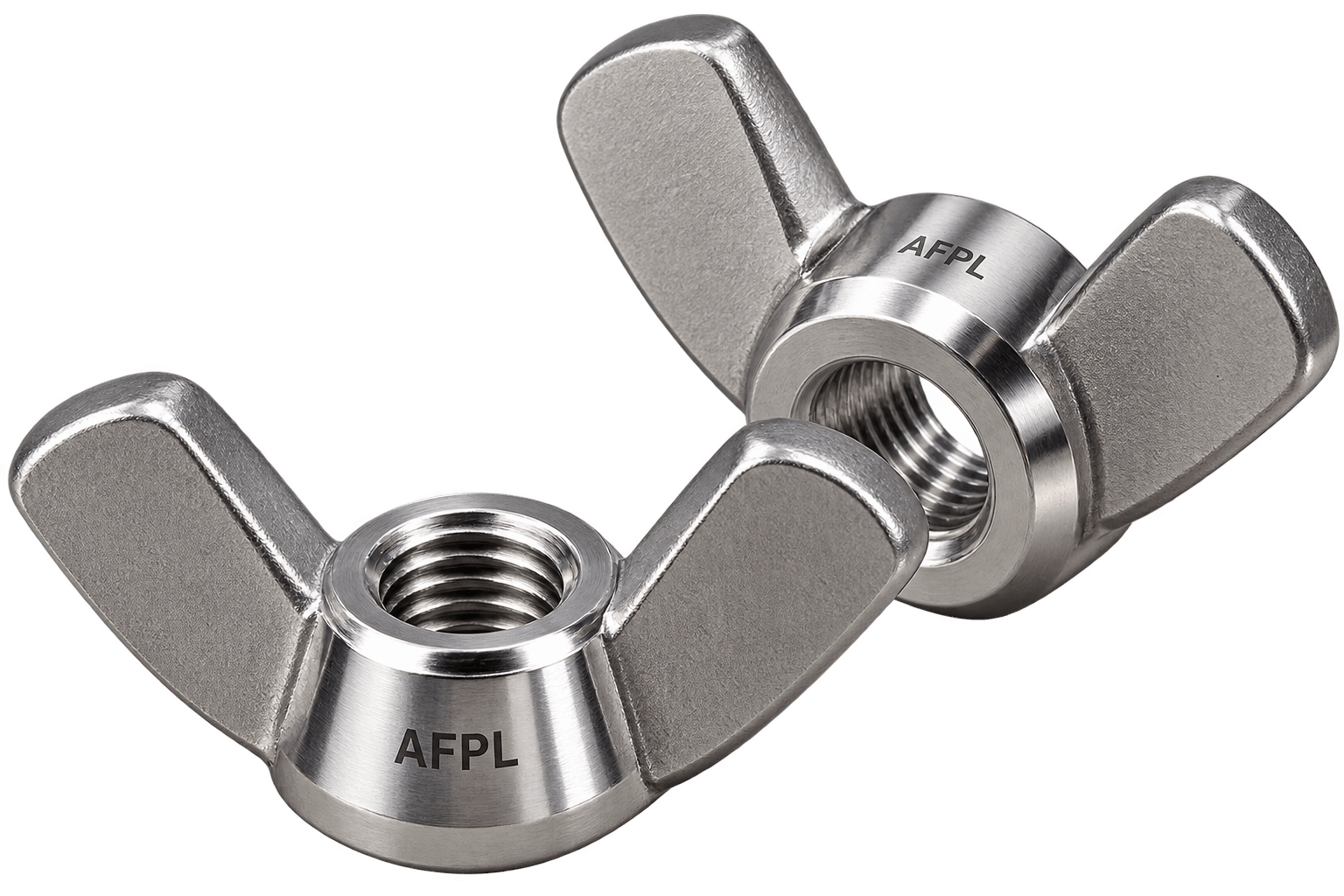
Every other nut Akbar Fasteners manufactures — hex, square, K-Lock, T-slot, weld — is designed around a tool: a wrench, socket, or welding electrode does the work of applying rotational force. A wing nut removes the tool from the equation entirely. In place of a hex or square body, two flat wings extend outward from the threaded body, wide enough and positioned correctly for a thumb and forefinger to grip and apply meaningful rotational torque without any mechanical assistance.
The Wing nuts manufacturer India length is a direct lever-arm — the further the wing extends from the thread centreline, the more torque a given hand-grip force can generate, exactly the same lever principle as a longer wrench handle generating more torque than a short one. This is why wing size scales with thread diameter across the standard range: a larger thread size, which requires more torque to seat correctly, is paired with proportionally larger wings to keep the hand-applied torque achievable without straining the fingers.
The honest limitation, stated plainly: hand torque is always lower than wrench torque — often by a factor of five to ten times, depending on the person and the wing size. A wing nut can never achieve the high clamping force of a properly torqued hex nut driven with a wrench, and it should never be specified for a connection where high, code-verified clamping tension is a safety requirement. Its correct use case is precisely the opposite scenario: connections that must be adjusted or removed frequently, quickly, and without needing to locate a tool — where the lower achievable clamping force is an acceptable trade for that convenience.
Why Wing Nuts — Convenience Traded Deliberately Against Clamping Force
No Tool to Carry, Lose, or Find
For access panels, battery terminals, and equipment that is opened and closed routinely by different people in different locations, requiring a specific wrench size for every adjustment is a genuine operational inconvenience — a wrench can be misplaced, forgotten, or simply not the right size at hand. A wing nut removes this dependency entirely; anyone with two working fingers can operate it.
Fast, Frequent Adjustment Without Tool Fatigue
Applications requiring repeated fine adjustment — tripod leg clamps, C-clamp workpiece holding, jig positioning — benefit from the speed of hand tightening over repeatedly fetching and using a wrench for each small adjustment. The time saved across dozens of daily adjustments in a workshop or field setting is a genuine productivity factor, not just a convenience.
Tactile Feedback Prevents Over-Tightening Damage
Because hand torque is inherently self-limiting — a person can only apply so much force with their fingers before it becomes physically uncomfortable — wing nuts naturally prevent the over-tightening that can crack plastic housings, strip soft-material threads, or damage delicate components clamped between two surfaces. This built-in torque ceiling is a genuine functional benefit in applications with fragile clamped materials.
Visually Obvious “No Tool Needed” Signal
A wing nut’s distinctive shape communicates its own operating instructions at a glance — anyone encountering it immediately understands it is meant to be turned by hand, with no ambiguity about whether a tool is required. This intuitive visual signalling is valuable in consumer products, public-facing equipment, and any application where the end user may not be technically trained.
Cast Wing Nut vs Stamped Wing Nut — Choosing Correctly
The two most common wing nut construction methods differ in wing thickness, feel, and cost — both fully functional, selected based on application requirement and budget.
Cast Wing Nut
Cast as a single solid piece with substantial, rounded wings and a smooth, rounded overall profile. Provides a comfortable, substantial grip feel and generally tolerates higher hand torque without wing deformation, at a higher unit cost than stamped construction.
Stamped Wing Nut
Formed from flat sheet metal stock, with thinner, flatter wings than a cast equivalent. More economical to manufacture at volume, and entirely adequate for lighter-duty hand-tightening applications where wing robustness under heavy repeated force is not the primary concern.
Wing Nut Material & Finish Options
Material selection follows the application’s corrosion exposure and — for brass — its use in electrical or decorative contexts.
Wing Nut Configurations & Related Hand-Fastened Hardware
Standard wing nuts across cast and stamped construction, plus matching thumb screws for the bolt-side equivalent. M4–M20.
Cast Wing Nut
Solid cast construction, rounded wing profile. M4–M20. The standard configuration for applications with frequent, substantial hand-tightening and a preference for durable wing construction over repeated use.
Stamped Wing Nut
Formed sheet metal construction, flatter wing profile. M4–M16. Economical configuration for high-volume consumer and light-duty applications where premium wing durability is not the primary requirement.
Thumb Screws
The bolt-side equivalent to a wing nut — a fully threaded screw with a flat, knurled or winged thumb head instead of a hex or socket head, for applications requiring hand-tightening on the male-threaded side of the connection rather than the nut side.
Custom Wing Nuts
Non-standard wing size for higher or lower hand-torque requirements, custom thread sizes, and drawing-specific configurations in any available material. Contact sales@akbarfasteners.in with thread size, construction type (cast/stamped), and material requirement.
Wing Nut Size Chart — M4 to M20
Thread size and typical overall wing span — note that wing span grows disproportionately faster than thread size to maintain achievable hand torque at larger diameters.
| Thread Size | Typical Wing Span (mm) | Typical Height (mm) |
|---|---|---|
| M4 | 22 | 13 |
| M5 | 25 | 15 |
| M6 | 28 | 17 |
| M8 | 36 | 21 |
| M10 | 42 | 25 |
| M12 | 48 | 29 |
| M16 | 58 | 36 |
| M20 | 70 | 42 |
Wing Nuts Application Areas
Access panels, workshop clamps, consumer equipment, and anywhere frequent tool-free adjustment matters more than maximum clamping force.
Equipment Access Panels
maintenance access hatches
Battery Terminals
marine battery connections
C-Clamps & Workshop Clamps
bench vice accessories
Tripods & Photography
quick-release plate hardware
Musical Instruments
music stand hardware
Laboratory Equipment
SS 316L instrument fastening
Sporting & Outdoor Gear
outdoor fixture hardware
Consumer Appliances
tool-free maintenance points
Wing Nut Standards Coverage
Same ISO 9001:2015 quality system as our complete fastener range. Wing dimension and thread compliance verified against DIN 315 on every production lot.
Complete Documentation Package
Material Stated
Wing Span · Thread
Conformance
(If Zinc Plated)
On Request
Related Nut Types & Materials
Wing nuts for tool-free hand-tightened connections. Full nut range for wrench-driven applications requiring higher clamping force. SS 316L and brass for corrosive or electrical environments.
Full Nut Range
Complete nut manufacturing capability at Akbar Fasteners — hex nuts, heavy hex, square, K-Lock, T-slot, weld, wing nuts, and all specialty forms across carbon steel through exotic alloy, all from a single Mumbai facility.
View Nut Range →K-Lock Nuts
For applications requiring high clamping force with vibration resistance — where a wing nut’s hand-torque limitation makes it unsuitable, a K-Lock nut delivers full wrench-driven clamping force with spring-and-serration anti-loosening.
View K-Lock Nuts →SS 316L Fasteners
For wing nut applications in marine, outdoor, or wash-down environments where carbon steel and zinc plating are insufficient — SS 316L wing nuts for laboratory equipment and coastal access panels.
View SS 316L →Brass Fasteners
For decorative and electrical wing nut applications requiring conductivity or a premium brass finish — battery terminal clamps and decorative hand-fastened hardware.
View Brass Range →Need Wing
Nuts?
Construction (cast/stamped) · thread size · material · finish · quantity. Akbar Fasteners Pvt. Ltd. responds within 24 hours.
Export: +91 8696 32 4646 · Support: +91 800 9315 333 · export@akbarfasteners.in