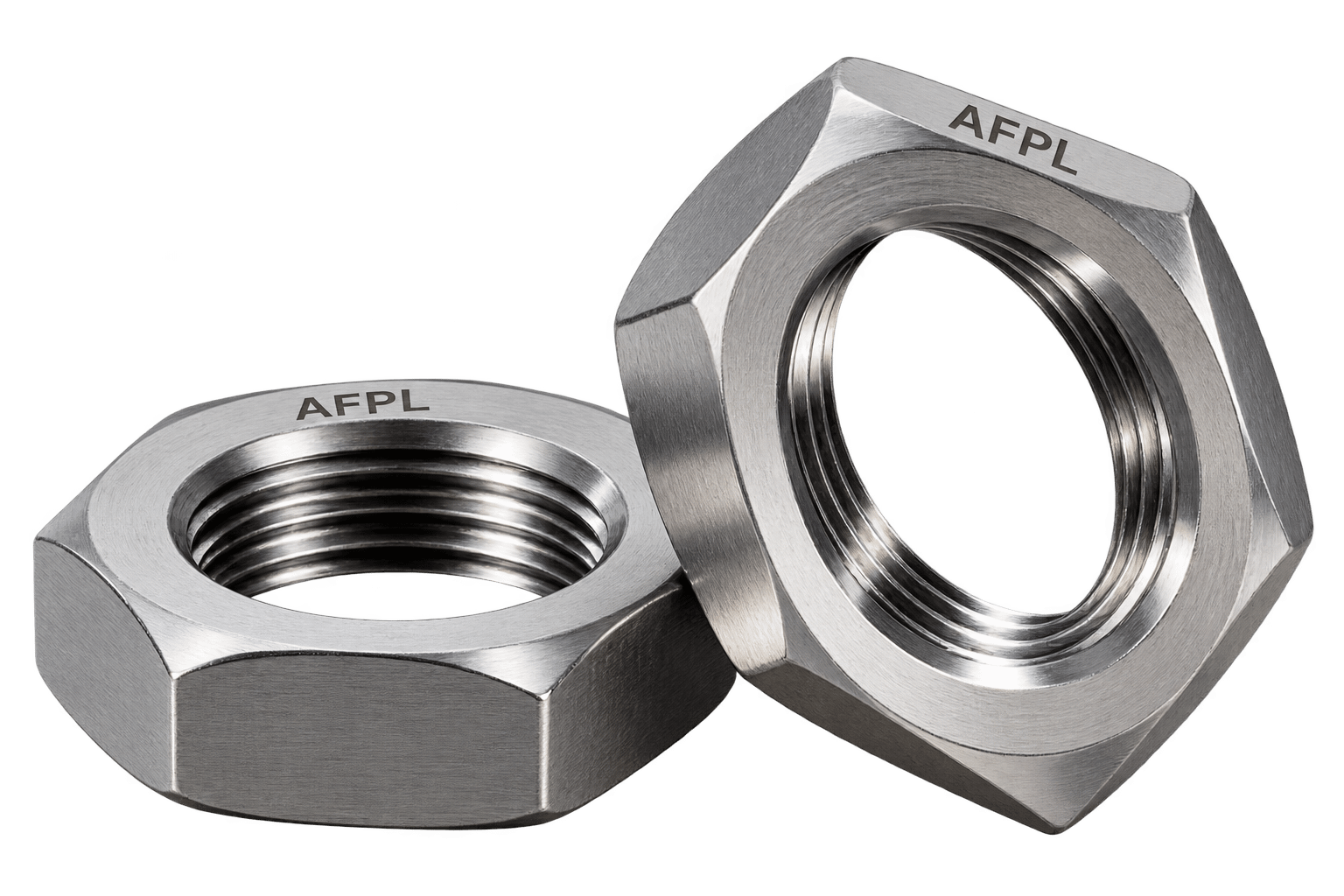
Jam Nuts
Why the Installation Order Genuinely Isn’t Optional
A jam nut’s defining feature is genuinely reduced height compared to a standard hex nut of the same thread size, designed to be tightened against a second, standard nut, or another jam nut, to create a locking effect through opposing thread flank contact.
Here is why this matters. The standard, full-height nut should genuinely be installed first, closest to the joint, and tightened to the full functional clamping torque, carrying the actual working load. The thinner jam nut should genuinely be installed second, outermost, and tightened last, torqued down against the standard nut. This creates opposing preload between the two nuts’ thread flanks, genuinely resisting loosening, because any rotational movement toward loosening must overcome both nuts’ opposing preload simultaneously, not just one nut’s static friction. Installing the nuts in the wrong order, with the thin jam nut first and the standard nut torqued against it last, is a genuine, common mistake that reduces locking effectiveness, since the full clamping torque would then be applied through the jam nut’s shorter, weaker thread engagement rather than the standard nut’s full engagement.
A genuine, honest limitation is worth stating plainly. Because this locking mechanism genuinely depends on getting the installation sequence correct, buyers and installers should confirm they understand which nut goes first, since a jam nut installed and torqued in the wrong order can genuinely provide less reliable locking than expected, or risk stripping the jam nut’s shorter thread engagement under full working load. A jam nut is not simply a thinner nut for tight spaces — its locking function depends specifically on the correct two-nut installation sequence, not on the jam nut’s geometry alone.
Akbar Fasteners Pvt. Ltd. exports to over 50 countries, and our jam nut range is manufactured and verified for thread and dimensional compliance under our ISO 9001:2015 quality system.
A Note on Confirming Installation Sequence Understanding
Please confirm your installation team understands the correct sequence, standard nut first at full torque, jam nut last against it, when requesting a quote — reversing this order genuinely weakens the locking effect.
Where This Product Genuinely Applies
Genuine Installation Sequence Guidance
We confirm your team understands the correct two-nut order before shipping.
Jam Nut vs Prevailing-Torque Guidance
We advise honestly when a nylon-insert lock nut genuinely suits the application better.
Matched Pair Confirmation
We confirm standard nut and jam nut are genuinely matched thread and grade.
Verified Dimensions & Mechanicals
Batch testing confirms genuine thread and height compliance for every lot.
Jam Nut Locking vs Prevailing-Torque Lock Nuts — Quick Reference
Confirming whether your installation team can genuinely guarantee the correct two-nut sequence, or a prevailing-torque lock nut’s built-in mechanism is genuinely more reliable for your process. This table is the quick reference we use with buyers before quoting.
| Aspect | Jam Nut Pair | Prevailing-Torque Lock Nut |
|---|---|---|
| Locking Mechanism | Genuinely opposing thread flank preload | Genuinely built-in friction/deformation |
| Installation Sequence Dependency | Genuinely critical, easy to get wrong | Genuinely none, single-nut installation |
| Best Fit | Genuinely adjustable/serviceable joints | Genuinely simpler single-nut assembly |
Jam Nut Specification Details
Grades We Supply
- Carbon Steel Grade 2, 5
- Stainless Steel 304, 316
- Alloy Steel Class 8, 10.9
- Coating Zinc, Black Oxide
What We Need
- Matching Standard Nut Grade Required
- Thread Size & Class Required
- Installation Process Confirmation Confirm on Enquiry
- Order Quantity & Form Per Order
Quality Practice
- Thread Gauge Inspection Every Lot
- Height/Thickness Verification Every Lot
- Tensile/Proof Load Testing Every Lot
- NABL Testing Available on Request
Application Areas
Wherever a controlled installation process can genuinely guarantee the correct standard-nut-first, jam-nut-last sequence.
Turnbuckles & Adjustable Rod Ends
using the correct two-nut sequence
Vibration-Prone Machinery Joints
against progressive loosening
Threaded Rod Positioning & Leveling Feet
after precise height adjustment
General Adjustable-Joint Locking Needs
a controlled two-nut sequence is genuinely achievable
Standard Export Documentation
Prepared as standard practice for every jam nut shipment.
Mill Test Certificate (MTC)
Material composition and mechanical property verification for every heat.
Height/Thickness Report
Confirms genuine jam nut height dimensions to specification.
Certificate of Conformance
Confirms the shipment matches the purchase order specification in full.
Certificate of Origin (COO)
Confirms India as country of manufacture for destination customs purposes.
NABL Accredited Test Reports
Independent mechanical and dimensional testing available on request.
Commercial Invoice & Packing List
Itemized value, Incoterm, and detailed carton/weight breakdown for customs clearance.
Internationally Recognised Standards Coverage
Related Products & Materials
2-Way Reversible Lock Nuts
Our single-nut prevailing-torque locking range, without sequence dependency.
View 2-Way Reversible Lock Nuts →Hex Nuts
Our standard full-height nut range, paired as the first nut in a jam nut installation.
View Hex Nuts →Tab Washers
Our positive mechanical locking range, an alternative locking mechanism entirely.
View Tab Washers →Fully Threaded Stud Bolts
Our continuous-thread stud range, commonly paired with jam nuts for adjustable positioning.
View Fully Threaded Stud Bolts →Tell Us Your
Matching Nut & Sequence Process
Share your matching standard nut grade and confirm your installation process follows the correct sequence — we’ll quote with full documentation. Akbar Fasteners Pvt. Ltd. responds within 24 hours.
Sales: +91 724 0000 733 · Support: +91 800 9315 333 · sales@akbarfasteners.in