Hex Coupling Nuts
Manufacturer
India · Mumbai
Anatomy of a Hex coupling nuts manufacturer India — A Splice, Not a Clamp
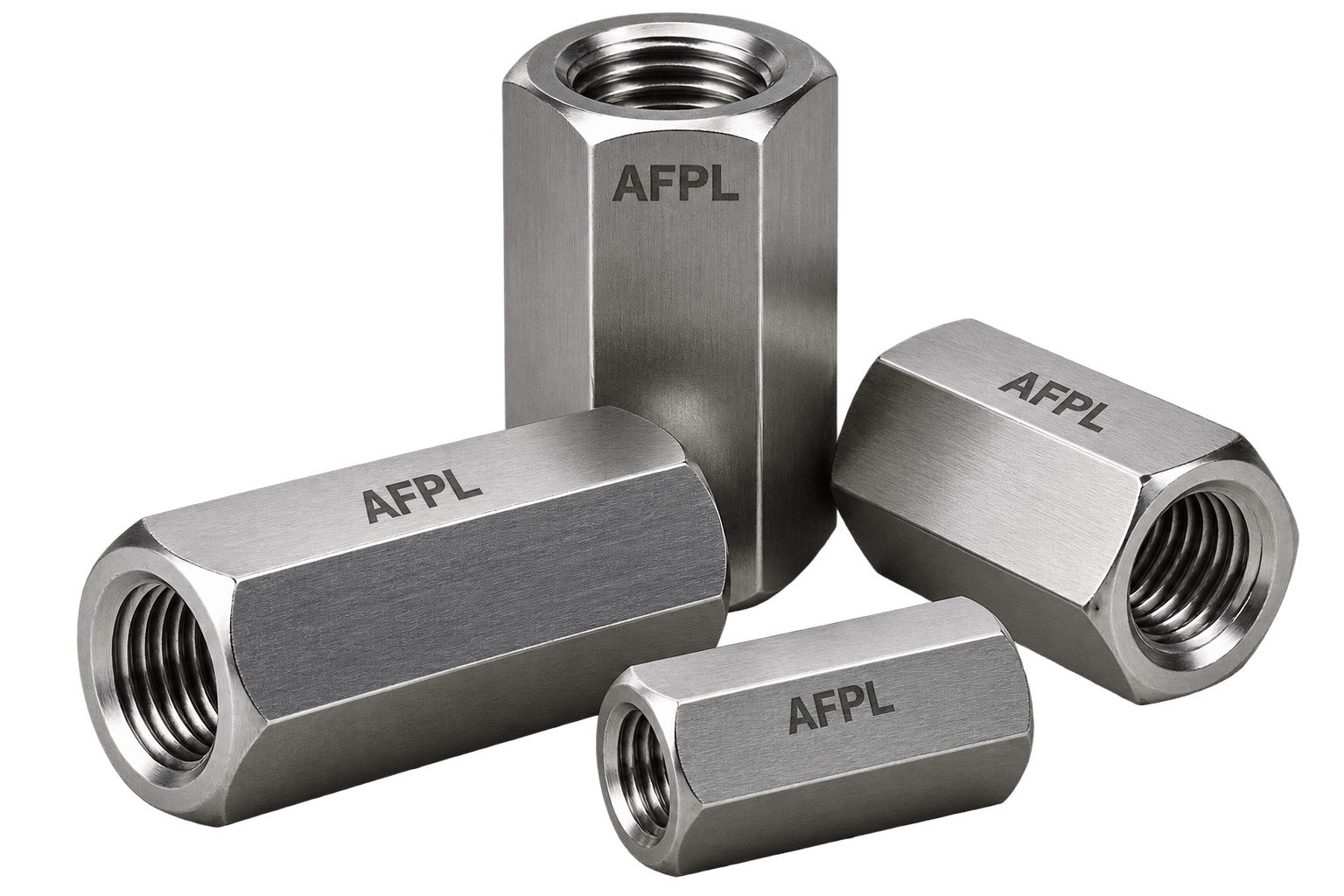
A hex coupling nut is a hex nut extended significantly in length — typically three times its nominal diameter or more, compared to roughly 0.8 times diameter for a standard hex nut — and threaded fully through its entire length from one end to the other. There is no flat bearing face anywhere on the part, and no surface it is ever tightened down against. Its sole function is to accept a threaded rod or stud from each end and join them into a single continuous effective length.
This is a categorically different function from every other nut in our range. A standard hex nut, heavy hex nut, or lock nut generates its clamping force by being torqued against a bearing surface, compressing a joint together along a single axis with a defined load path through that face. A coupling nut has no clamping function and no bearing face to generate one — instead, load is transferred axially from one rod, through the shared internal thread, into the second rod, purely through shear across the engaged thread length on each side. The nut itself never bears against anything external; it exists entirely to be a threaded connector between two other parts.
Because there is no bearing face to indicate when a rod is fully seated, thread engagement length becomes the single critical variable governing joint strength — a detail with no real equivalent among our other bolted products, and covered in detail below.
Why Hex Coupling Nuts — Extending Length Without Cutting New Thread
Extends Threaded Rod to Any Required Length
Rather than sourcing a single custom-length threaded rod for every application, a coupling nut lets two standard-length rods be joined on site to reach the exact length a suspended ceiling grid, hanger system, or tie rod run actually requires.
Field-Adjustable Without Cutting or Re-Threading
Extending or shortening a threaded rod run in the field is as simple as adding or removing a length of rod at a coupling nut joint — no cutting, no re-threading, and no specialised tooling required beyond a wrench.
Standard Solution Across Hanger and Suspension Systems
Suspended ceiling grids, HVAC ductwork hangers, and cable tray support systems routinely specify coupling nuts as the standard method of extending threaded hanger rod to reach the required drop length from structure to fixture.
Available in Reducing Configurations for Dissimilar Thread Sizes
Where two ends of a run use different thread sizes — a common situation when adapting between different hanger systems or structural tie rod specifications — a reducing coupling nut joins them directly without requiring an intermediate adapter component.
Equal Engagement — Both Rods Must Be Threaded In Far Enough
Because a coupling nut has no bearing face, there is no shoulder, no flat, and no “bottoming out” sensation to tell an installer when a rod has been threaded in far enough — unlike a conventional bolt, where reaching full engagement against a bearing face is immediately obvious both by feel and by sight. A coupling nut joint can look and feel perfectly assembled from the outside while one or both rods are actually threaded in only a short distance, well short of the engagement length needed to develop the joint’s full rated strength.
Because load is transferred entirely through thread shear across the engaged length, the weaker of the two engagement lengths governs the strength of the entire connection — a rod threaded in fully on one side provides no benefit if the opposite side is barely engaged. The joint is only as strong as its shortest engagement, exactly the way a chain is only as strong as its weakest link.
The correct installation practice is straightforward but must be deliberately followed rather than assumed: each rod should be threaded in until it reaches, or very nearly reaches, the centre of the coupling nut’s length — commonly verified by marking the rod at the correct insertion depth before assembly, or by using a coupling nut with a visible centre witness mark or drilled inspection hole, since there is no other way to confirm engagement depth once the joint is assembled and the rod ends are hidden inside the nut.
Standard vs Reducing Hex Coupling Nuts
Both join two rods end-to-end — the reducing form additionally bridges two different thread sizes.
Standard Coupling Nut
Identical thread size and pitch throughout the full length, joining two rods of the same size end-to-end. The default configuration for the large majority of hanger rod extension and structural tie rod splicing applications.
Reducing Coupling Nut
Different thread size and/or pitch machined at each end, allowing two rods of different diameters to be joined directly in a single component — avoiding the need for a separate step-down adapter piece between two dissimilar hanger or structural systems.
Hex Coupling Nut Material & Strength Options
Grade selection follows the rod being spliced — the coupling nut should always match or exceed the threaded rod’s own property class.
Hex Coupling Nut Configurations & Related Hardware
Standard and reducing coupling nuts across the full material range, plus matching threaded rod. M6–M36.
Standard Coupling Nut
Elongated hex body, same thread size both ends per DIN 6334. M6–M36. The default configuration for splicing same-size threaded rod across suspension and structural applications.
Reducing Coupling Nut
Different thread size at each end. M8–M30 combinations. Joins two dissimilar rod diameters directly, avoiding a separate step-down adapter.
Threaded Rod (All-Thread)
Full-length threaded rod matched to coupling nut thread size and grade, available in standard stock lengths for cutting to the exact drop or run length required.
Custom Coupling Nuts
Non-standard lengths for longer engagement runs, custom reducing combinations, and drawing-specific configurations. Contact sales@akbarfasteners.in with thread sizes and grade requirement.
Hex Coupling Nut Size Chart — M6 to M36
Across-flats dimension and standard body length — each side provides roughly half the total length for rod engagement.
| Thread Size | Across Flats (mm) | Body Length (mm) | Engagement Per Side (mm) |
|---|---|---|---|
| M6 | 10.0 | 18.0 | ~9.0 |
| M8 | 13.0 | 24.0 | ~12.0 |
| M10 | 17.0 | 30.0 | ~15.0 |
| M12 | 19.0 | 36.0 | ~18.0 |
| M16 | 24.0 | 48.0 | ~24.0 |
| M20 | 30.0 | 60.0 | ~30.0 |
| M24 | 36.0 | 72.0 | ~36.0 |
| M30 | 46.0 | 90.0 | ~45.0 |
Longer body lengths are available on request for applications requiring greater engagement length per side than the standard body provides.
Hex Coupling Nuts Application Areas
Wherever a threaded rod run needs to be extended, joined, or field-adjusted to reach a specific length.
Suspended Ceiling Systems
drop-length field adjustment
HVAC Ductwork Hangers
hanger system extension
Cable Tray & Conduit Support
electrical hanger systems
Structural Tie Rod Extension
long-run tie rod assemblies
Scaffolding & Formwork
formwork threaded rod extension
Solar Mounting Structures
ground-mount tie rod extension
Marine Structural Rod Splicing
dock and structural rod extension
Industrial Equipment Assembly
general equipment tie rods
Hex Coupling Nut Standards Coverage
Same ISO 9001:2015 quality system as our complete fastener range. Body length and thread engagement verified against DIN 6334 on every production lot.
Complete Documentation Package
Grade / Standard Stated
Body Length · Across Flats
Conformance
ASTM A153 (if HDG)
On Request
Related Nut Types & Materials
Coupling nuts for rod splicing and extension. Standard hex nuts and heavy hex nuts for conventional bearing-face clamping. SS 316L for corrosive rod-extension applications.
Full Nut Range
Complete nut manufacturing capability at Akbar Fasteners — hex, heavy hex, square, coupling, K-Lock, and all specialty forms across carbon steel through exotic alloy.
View Nut Range →Heavy Hex Nuts
The conventional bearing-face alternative for matched stud bolt clamping duty — contrasted with the coupling nut’s no-bearing-face splicing function.
View Heavy Hex Nuts →SS 316L Fasteners
For coupling nut applications in marine, coastal, or corrosive-environment rod extension where carbon steel’s corrosion resistance is insufficient.
View SS 316L →Full Bolt Range
Complete bolt manufacturing capability at Akbar Fasteners for the conventional bearing-face fastening this product deliberately does not perform.
View Bolt Range →Need Hex Coupling
Nuts?
Thread size(s) · standard or reducing · grade · quantity. Akbar Fasteners Pvt. Ltd. responds within 24 hours.
Export: +91 8696 32 4646 · Support: +91 800 9315 333 · export@akbarfasteners.in