
Eye Bolts
Manufacturer
Mumbai · India
Forged vs Machined Eye Bolts — Why It Matters
A genuinely forged eye bolt has continuous, unbroken grain flow running through the eye and shank — the metal is shaped under heat and pressure so its internal grain structure follows the actual geometry of the part, which is precisely what gives a forged eye bolt its rated lifting strength. Standards like DIN 580 and DIN 6899 are written specifically around forged construction, with load ratings that assume that grain flow is present.
A machined eye bolt, by contrast, is cut from bar stock — the eye is drilled or bored out of round bar rather than forged into shape, which cuts across the grain flow rather than following it. That’s not automatically unsafe, but it does mean the part is genuinely weaker than a forged equivalent of the same dimensions, and it should never be assumed to carry a DIN-rated working load limit unless the specific machined item has been independently tested and rated for that duty. Buying an eye bolt without knowing which manufacturing method produced it is buying an unknown quantity for a lifting application — exactly the situation genuinely worth avoiding.
Akbar Fasteners Pvt. Ltd. manufactures both genuinely forged eye bolts to DIN 580/582/6899 for rated lifting duty, and machined eye bolts for lower-duty or non-lifting fixing applications — and we’re explicit about which is which on every order, rather than leaving the buyer to guess.
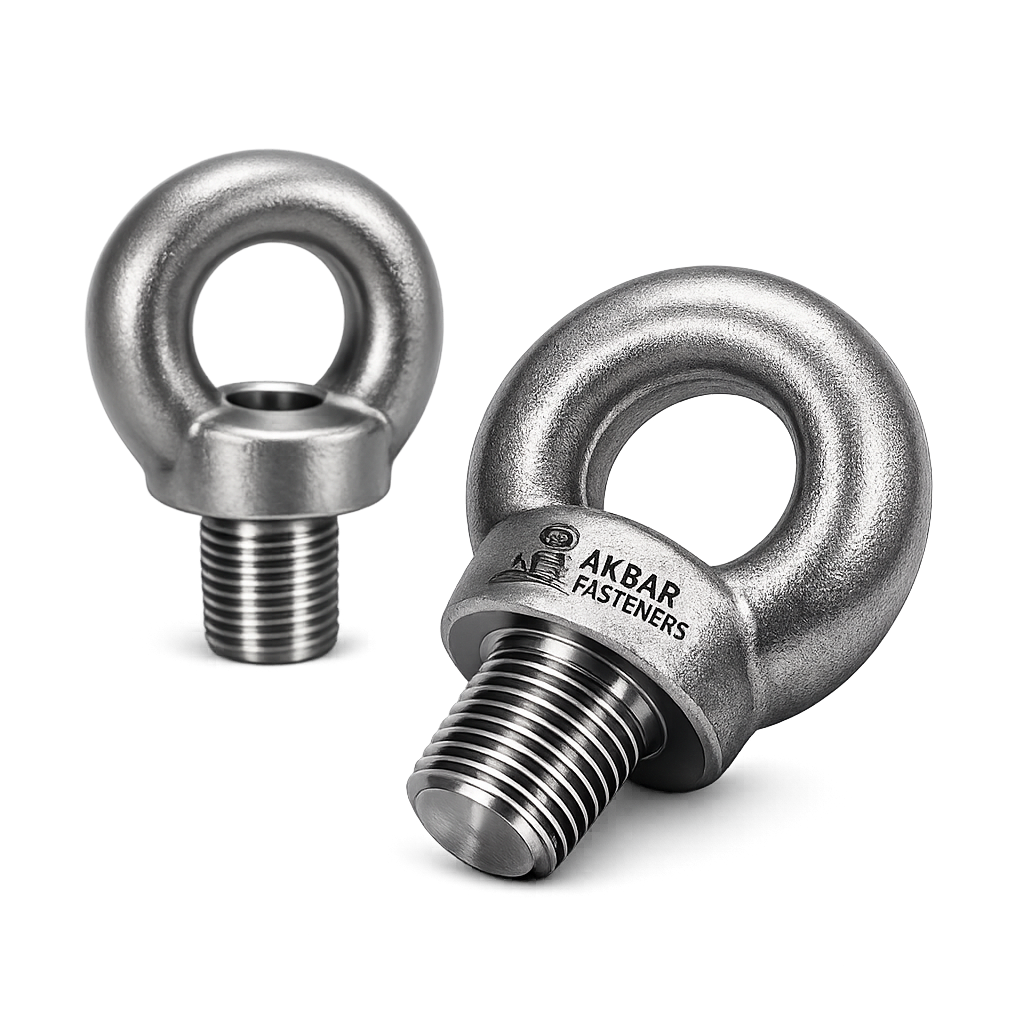
Eye Bolts Manufactured With Rated Duty in Mind
Genuine Forged Construction
Our DIN-rated eye bolts are hot forged, not machined from bar, preserving the continuous grain flow the standard assumes.
Marked, Traceable WLL
Every rated eye bolt is marked with its working load limit and manufacturer identification, per standard practice.
Full Material Range
Carbon steel, stainless steel, and alloy steel eye bolts manufactured across a genuine size range.
ISO 9001:2015 Quality System
Batch-tested and documented manufacturing, matching the accountability a lifting-rated product genuinely demands.
Eye Bolt Types Explained
Plain (Shoulder) Eye Bolts
Rated for vertical, straight-line lifting only — side loading a DIN 580 eye bolt is a common and dangerous misuse.
Eye Bolts With Collar/Washer
Includes a shoulder washer specifically designed to permit rated angular lifting, unlike plain DIN 580 bolts.
Long-Pattern Eye Bolts
Extended shank forged eye bolts for deeper thread engagement in specific mounting geometries.
Swivel Hoist Rings
Load-rated swivel rings permitting rotation and multi-directional pull, for rigging where load orientation changes.
What to Get Right Before You Lift
Never Side-Load a Plain DIN 580 Eye Bolt
Plain eye bolts are rated for in-line vertical lift only — angular loading dramatically reduces actual capacity below the marked WLL and is a leading cause of eye bolt failure.
Fully Seat the Shoulder Against the Mounting Surface
An eye bolt’s rated capacity assumes its shoulder is drawn down fully flush — a gap under the shoulder changes the load path and reduces safe capacity.
Match Thread Engagement Depth to the Standard
Insufficient thread engagement in the tapped hole undermines the rated capacity regardless of the eye bolt’s own strength.
Confirm the WLL Marking Before Every Use
Never assume an unmarked or unidentified eye bolt is rated for lifting — treat it as a fixing fastener only until proven otherwise.
Eye Bolt Specification Details
Materials We Manufacture In
- Carbon Steel C15 / EN8 Forged
- Stainless Steel 304 / 316
- Alloy Steel Where Higher Duty Needed
- Finish Zinc Plated / Bright / Passivated
How Rated Eye Bolts Are Made
- Process Hot Forged
- Heat Treatment As Required Per Grade
- Marking WLL, Manufacturer ID
- Testing Proof Load per Batch
Available Dimensions
- Metric Thread M6 – M64
- Standard DIN 580 / 582 / 6899
- Custom Sizes Available to Drawing
- Matching Hardware Shackles, Slings on Request
Working Load Limit vs Breaking Load
The marked WLL is not the point of failure — it already has a safety factor built in. This table clarifies the relationship that buyers should understand before specifying an eye bolt for a lifting application.
| Term | What It Means | Practical Note |
|---|---|---|
| Working Load Limit (WLL) | Maximum load rated for safe, repeated use | The number stamped on the eye bolt — never exceed it |
| Design/Safety Factor | Typically 4:1 or 5:1 over breaking load | Built into the WLL — not a margin to use up |
| Minimum Breaking Load | Load at which the part is expected to fail | Reference value only — never a working limit |
| Angular Load Derating | Reduced capacity at non-vertical angles | Applies even to collar-type eye bolts rated for angular lift |
Application Areas
Lifting, rigging, and anchor-point applications across industry.
Machinery Lifting Points
or tapped into equipment
Rigging & Crane Operations
attachment points
Marine & Container Handling
points on containers/cargo
Construction Site Lifting
structural component lifting
Electrical & Panel Enclosures
equipment installation
Wire Rope & Tensioning Systems
guy wires and tensioners
General Fixing (Non-Rated)
not for lifting duty
General Industrial Use
demanding lifting environments
Standard Export Documentation
Prepared as standard practice for every rated eye bolt shipment.
Mill Test Certificate (MTC)
Heat number, chemical composition, and mechanical property verification for every lot.
Proof Load Test Records
Batch-level proof load testing documentation for rated lifting eye bolts.
Certificate of Conformance
Confirms the shipment matches the purchase order specification and standard in full.
Certificate of Origin (COO)
Confirms India as country of manufacture for destination customs purposes.
NABL Accredited Test Reports
Independent mechanical and load testing available on request for critical applications.
Commercial Invoice & Packing List
Itemized value, Incoterm, and detailed carton/weight breakdown for customs clearance.
Internationally Recognised Standards Coverage
Related Fastener Grades & Materials
Different Types of Nuts and Bolts
A broader guide to bolt head types, drive types, and general fastener categories.
View Nuts & Bolts Guide →High Tensile Bolts Specifications
Property class detail relevant to matching eye bolt material grade to load requirements.
View High Tensile Specs →Stainless Steel Fasteners Manufacturer in India
Our full stainless steel range, relevant for corrosion-resistant eye bolt material selection.
View Stainless Range →Fastener Applications By Industry
A broader guide to matching fastener material grades to the right industry and environment.
View Applications Guide →Need a Genuinely
Rated Lifting Eye Bolt?
Tell us your load, lifting angle, and thread size — we’ll confirm whether DIN 580 or DIN 582 fits, and supply forged, WLL-marked eye bolts with full documentation. Akbar Fasteners Pvt. Ltd. responds within 24 hours.
Sales: +91 724 0000 733 · Support: +91 800 9315 333 · sales@akbarfasteners.in