Carriage Bolts
Manufacturer
India · Mumbai
Anatomy of a Carriage bolts manufacturer India — The Head Is Smooth on Purpose
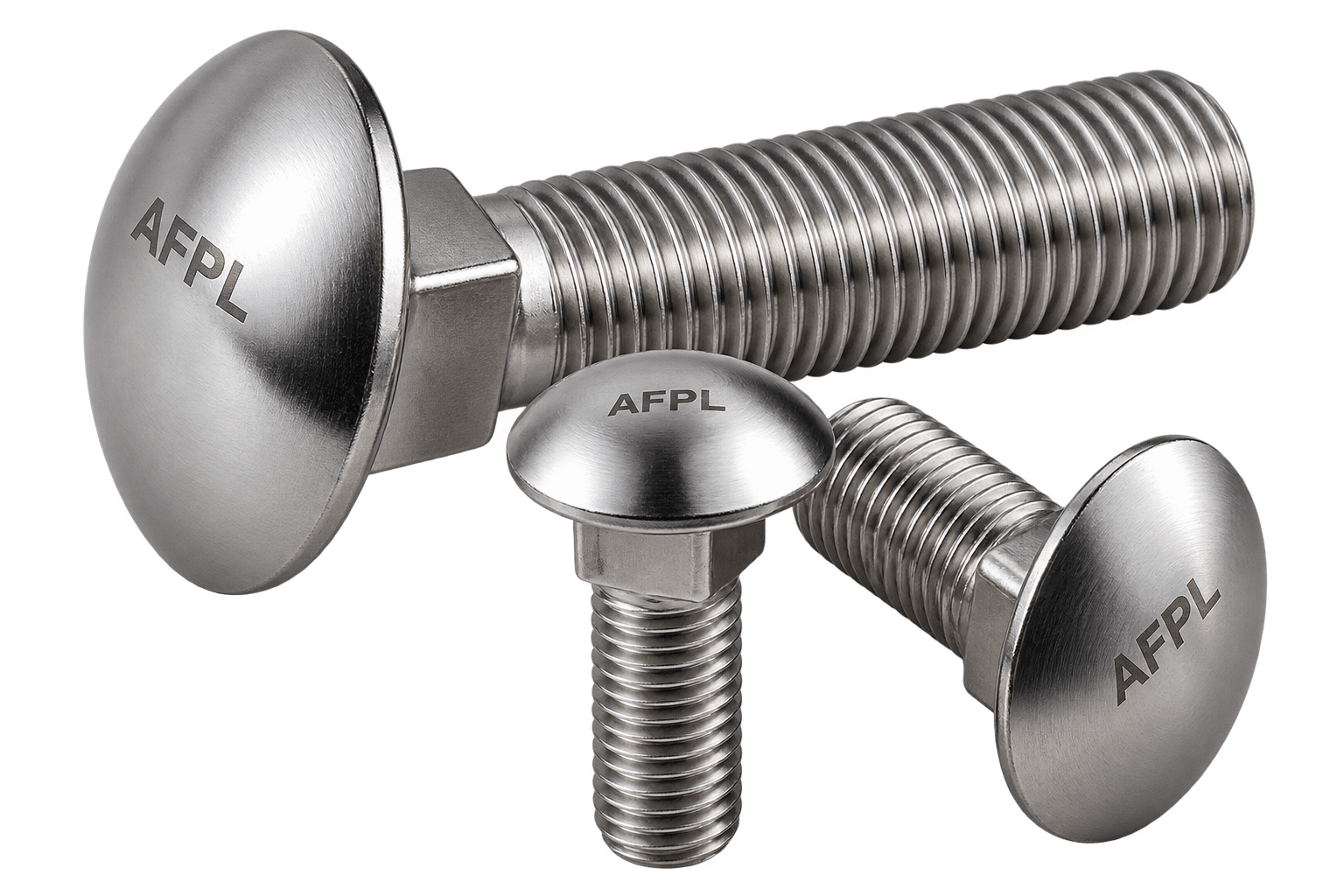
A carriage bolt has a low, rounded dome head with no flats, no drive recess, and no wrenching feature of any kind — it is designed to never be gripped by a tool at all. Directly beneath the dome sits a short square-section neck before the threaded shank begins. The entire mechanical purpose of this design is to let the bolt be dropped into a round pre-drilled hole from one side, then tightened entirely from the opposite side, without ever needing access to, or a tool on, the head.
As the nut is turned onto the exposed threaded end and tightened, the bolt is drawn upward, and the square neck — which is slightly larger across its corners than the round hole — is pulled firmly into that hole. Because the surrounding material is timber, the square corners bite into and locally compress the wood fiber, cutting their own snug square seat as the joint is drawn tight. This happens automatically, in the single motion of tightening the nut — no separate step, no pre-cut square recess, no second tool.
This is the key distinction from our square head bolts, which look superficially similar but solve a different problem: a square head bolt’s entire head is a wrenchable square, intended to seat into a square recess that has already been machined into harder material like steel or cast iron, since metal will not deform to accept the square the way wood does. A carriage bolt’s neck, by contrast, actively forms its own keyway on installation — a mechanism that only works because wood is soft enough to be locally displaced by the corners as the joint is tightened.
Why Carriage Bolts — The Standard Answer for Wood-to-Wood Joints
No Access Required on the Head Side
Because the entire installation is completed by turning the nut on the far side, carriage bolts are the correct choice whenever the head end of the connection is difficult, dangerous, or impossible to reach with a tool — a common condition in decking, framing, and enclosed timber structures.
Smooth, Snag-Free Exposed Surface
The rounded dome presents nothing for hands, clothing, or passing objects to catch on — the standard reason carriage bolts are specified on the visible, touchable side of decking, playground equipment, park benches, and picnic tables.
Genuine Anti-Rotation Without a Separate Locking Feature
The neck’s bite into the wood does the anti-rotation work entirely on its own — no lock washer, no thread-locking compound, and no separate mechanical feature is required simply to keep the bolt from spinning while the nut is tightened.
Simple, Low-Cost, Widely Stocked
As one of the oldest and most standardised timber fastener forms, carriage bolts are inexpensive to manufacture and universally recognised by builders and tradespeople — a straightforward specification with no special tooling or training required to install correctly.
The Self-Forming Keyway — Why This Only Works in Wood
The square neck beneath a carriage bolt’s head is deliberately sized slightly larger across its corners than the round hole it’s dropped into. This is not a manufacturing tolerance to work around — it is the entire design intent. As the nut is tightened and draws the bolt upward, those oversized corners are forced into the surrounding wood, locally compressing and displacing the fiber to create a snug, close-fitting square recess exactly matching the neck’s shape — a keyway that did not exist before installation and required no separate cutting or machining step to produce.
This self-forming behaviour is only reliably possible in a material soft enough to be locally displaced by the corners under normal tightening torque — timber and similar softer materials. It is the reason carriage bolts are overwhelmingly a wood fastener, and the reason our square head bolts exist as a separate product: in steel, cast iron, or other hard material, the corners cannot displace anything, so the anti-rotation function has to come from a square recess that is deliberately pre-machined into the material before the bolt is ever inserted.
Where a carriage bolt is used to fasten timber to a metal bracket or plate rather than wood-to-wood, this same principle still applies on the wood side of the joint — the metal side simply needs a clearance hole large enough for the neck to pass through freely, since there is no fiber on that side for the corners to bite into. Getting this detail right — treating the neck’s grip as a wood-specific mechanism rather than assuming it works identically against any material — is the single most important thing to understand when specifying carriage bolts correctly.
Square Neck vs Ribbed Neck Carriage Bolts
Both bite into wood on tightening — the ribbed form spreads the same self-forming principle across more, smaller contact points.
Square Neck Carriage Bolt
The traditional, most widely available configuration — a short square-section neck providing four corner contact points that bite into the wood as the joint is tightened. The default specification for the large majority of general timber fastening.
Ribbed Neck Carriage Bolt
A series of small longitudinal ribs around the neck’s circumference in place of a single square, distributing the self-forming bite across more, finer contact lines. Can offer a more consistent grip in denser or harder timber species where a plain square corner might tend to shear rather than displace fiber cleanly.
Carriage Bolt Material & Finish Options
Hot-dip galvanized carbon steel is the standard for outdoor timber applications; stainless for marine or high-corrosion environments.
Carriage Bolt Configurations & Related Hardware
Standard square neck and ribbed neck variants across the full material range, plus matching washers and nuts. M6–M20.
Square Neck Carriage Bolt
Standard round dome head, square-section neck per DIN 603. M6–M20. The default configuration for general timber fastening across decking, fencing, and furniture applications.
Ribbed Neck Carriage Bolt
Round dome head with longitudinal rib neck per ISO 8677. M8–M16. Finer, distributed bite for dense hardwood species and applications preferring the ribbed embedding form.
Matching Flat Washers
Plain flat washers matched to carriage bolt thread size and grade — commonly specified beneath the nut on the far side to distribute bearing load into the second timber face.
Custom Carriage Bolts
Non-standard lengths, custom neck dimensions for specific timber thickness, and drawing-specific configurations. Contact sales@akbarfasteners.in with thread size, length, and finish requirement.
Carriage Bolt Size Chart — M6 to M20
Head diameter and square neck across-corners dimension — confirm pre-drilled hole diameter against neck size before installation.
| Thread Size | Head Diameter (mm) | Neck Across Corners (mm) | Recommended Drill Ø (mm) |
|---|---|---|---|
| M6 | 14.0 | 6.6 | 6.5 |
| M8 | 18.0 | 8.8 | 8.5 |
| M10 | 22.0 | 11.0 | 10.5 |
| M12 | 26.0 | 13.2 | 12.5 |
| M16 | 33.0 | 17.6 | 16.5 |
| M20 | 40.0 | 22.0 | 20.5 |
Drilled hole should be slightly undersized relative to neck across-corners to ensure the self-forming bite fully engages — confirm against timber species and joint thickness.
Carriage Bolts Application Areas
Timber and wood-to-metal fastening wherever a smooth exposed head and tool-free installation matter.
Decking & Timber Structures
structural timber connections
Fencing & Gates
gate hardware fastening
Playground Equipment
smooth head injury prevention
Outdoor Furniture
visible smooth-head fastening
Agricultural Timber Structures
livestock enclosure timber
Wood-to-Metal Bracket Joints
clearance-hole metal side
Marine Timber Dock Hardware
coastal boardwalk hardware
General Timber Framing
general wood-to-wood joints
Carriage Bolt Standards Coverage
Same ISO 9001:2015 quality system as our complete fastener range. Neck dimension and head profile verified against DIN 603 on every production lot.
Complete Documentation Package
Grade / Standard Stated
Neck Size · Head Ø
Conformance
ASTM A153 (if HDG)
On Request
Related Bolt Types & Materials
Carriage bolts for wood-embedded connections. Square head bolts for pre-machined metal-to-metal square recesses. Full bolt range for the complete fastening schedule. SS 316L for marine timber applications.
Square Head Bolts
The metal-recess alternative — a fully wrenchable square head requiring a pre-machined square hole, contrasted with the carriage bolt’s self-forming neck bite into soft timber.
View Square Head Bolts →Full Bolt Range
Complete bolt manufacturing capability at Akbar Fasteners — carriage, square head, machine, socket head, and all specialty head forms across carbon steel through exotic alloy.
View Bolt Range →SS 316L Fasteners
For carriage bolt applications in marine timber decking, coastal boardwalks, and wet-exposure structures where carbon steel’s corrosion resistance is insufficient.
View SS 316L →Full Nut Range
Hex nuts and matched washers for the far side of every carriage bolt connection, across our complete material range.
View Nut Range →Need Carriage
Bolts?
Neck type (square/ribbed) · thread size · length · finish · quantity. Akbar Fasteners Pvt. Ltd. responds within 24 hours.
Export: +91 8696 32 4646 · Support: +91 800 9315 333 · export@akbarfasteners.in