J-Bolts
Manufacturer
India · Mumbai
Anatomy of a J-bolts manufacturer India — The Hook That Locks into Concrete
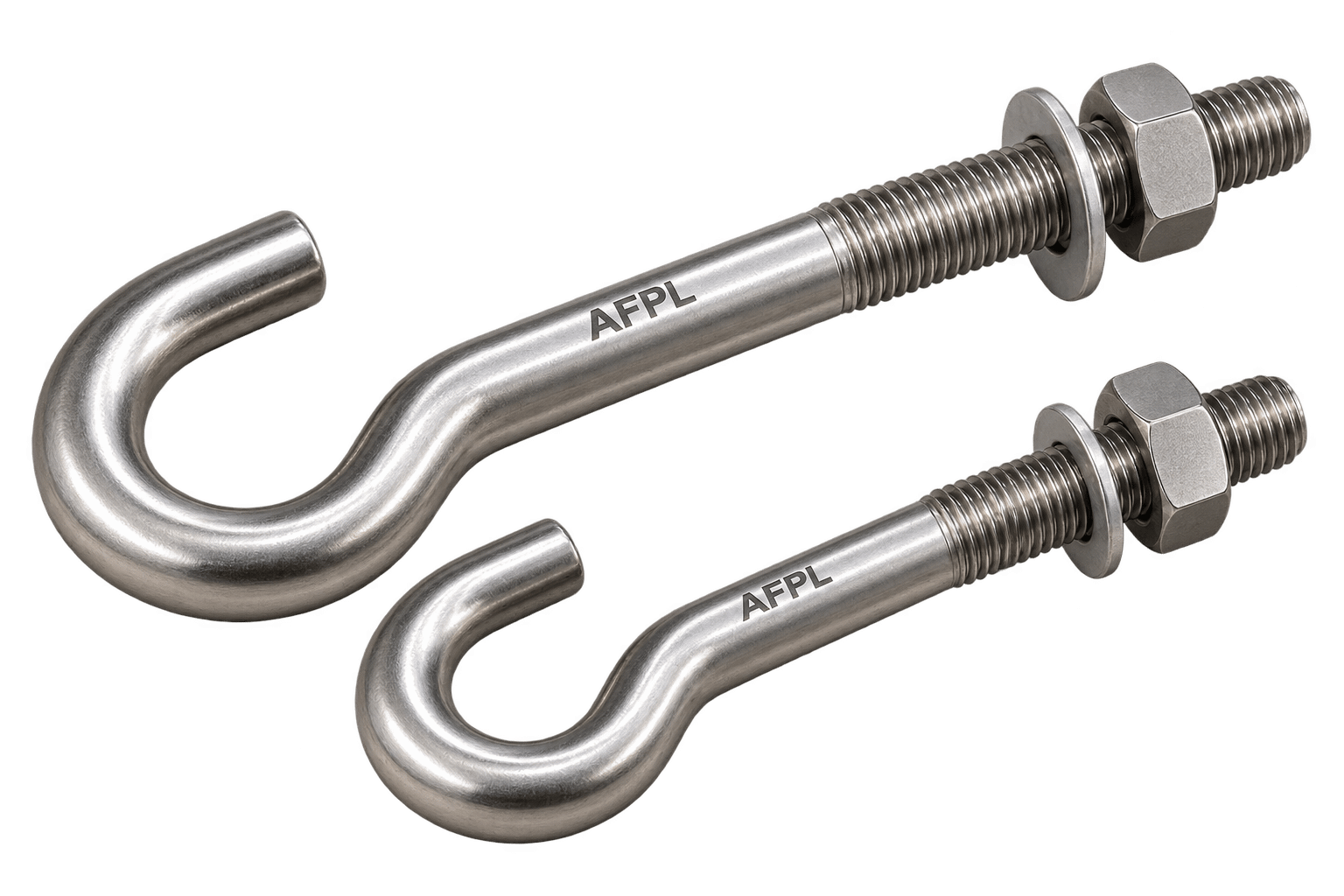
A J-bolt is a length of threaded rod with one end bent into a hook resembling the letter J — typically a 180° bend forming a curved tail. Before a concrete foundation is poured, J-bolts are positioned in the formwork at the exact spacing required by the base plate bolt pattern, with the hook end down inside the pour zone and the threaded end projecting up through a template to the correct height above the finished concrete surface. When the concrete cures around the embedded hook, the bolt is permanently locked in place — the hook shape provides mechanical resistance against pull-out that a straight embedded rod could not achieve on its own.
The pull-out resistance mechanism is purely mechanical: as tension is applied to the exposed threaded end (from wind load on a pole, seismic load on a structural column, or vibration on machinery), the load tries to pull the embedded end straight and out of the concrete. The J-hook’s curved geometry means the concrete directly above and around the hook must fail in compression and shear before the bolt can pull free — this is a far higher resistance than the bond strength between a straight rod and the surrounding concrete alone.
Embedment depth is the critical design parameter — not just hook length. Structural engineering calculations (per ACI 318 or IS 456 concrete design codes) determine the required embedment depth based on the bolt diameter, concrete grade, and the design tension load, and this embedment depth typically far exceeds the hook length alone — the straight shank above the hook also contributes bond resistance along its embedded length. J-bolt total length is therefore always specified as embedment depth + hook allowance + projection above concrete, not simply “bolt length.”
Why J-Bolts — The Standard Cast-In Foundation Anchor
Lowest-Cost Cast-In Anchoring Method
J-bolts are simply bent threaded rod — no forged head, no machined shoulder, no specialty manufacturing process beyond bending and threading. For projects with large quantities of foundation anchors (light pole installations, fence lines, solar farm racking), J-bolts are the most economical cast-in-place anchoring solution per anchor point, which is why they remain the default specification across civil and structural engineering despite newer proprietary anchor systems being available.
Proven Mechanical Pull-Out Resistance
The J-hook geometry has a century of proven structural engineering use and is directly calculable using standard concrete anchorage design methods (ACI 318 Appendix D or IS 456 Annex). Unlike some proprietary mechanical or adhesive anchor systems that require specific manufacturer load tables, J-bolt pull-out capacity can be calculated by any structural engineer using published concrete design code methodology — no proprietary design software or manufacturer certification dependency.
Template-Set Accuracy for Multi-Bolt Patterns
J-bolts are positioned using a template (a jig holding the bolts at the exact base plate bolt-hole spacing) before the concrete pour, ensuring the finished bolt pattern precisely matches the base plate that will be installed weeks or months later after the concrete has cured. This template-setting method is essential for structural steel column base plates and light pole foundations where bolt pattern accuracy of a few millimetres determines whether the base plate fits without field modification.
No Drilling Required — Set Before the Pour, Not After
Unlike post-installed anchors (expansion bolts, chemical anchors) that require drilling into cured concrete, J-bolts are embedded during the original pour — eliminating drilling dust, rebar-strike risk, and the reduced pull-out capacity that comes from drilling close to a concrete edge or existing reinforcement. For new construction where the foundation design and anchor bolt layout are known in advance, cast-in J-bolts are structurally superior to any post-installed alternative at the same embedment depth.
J-Bolt vs L-Bolt vs U-Bolt — Anchor Shape Comparison
All three are bent threaded rod anchors sharing the same cast-in-place principle. The bend angle and shape determine pull-out resistance, ease of positioning, and typical application.
J-Bolt
A 180° curved hook at the embedded end — the tightest bend radius of the three shapes, providing the highest pull-out resistance per unit of embedded hook length because the concrete must fail through the greatest amount of curved bearing surface to release the bolt.
L-Bolt
A single 90° bend rather than a full hook — simpler to manufacture and typically used where the embedment length itself (rather than hook curvature) provides most of the pull-out resistance, or where the 90° foot needs to sit flat against a lower reinforcement layer.
U-Bolt (Foundation Type)
A full loop with both ends threaded and projecting above the concrete — effectively two anchor points from one continuous embedded piece, with the loop bottom providing substantial bearing area against pull-out from either projecting end simultaneously.
J-Bolt Material & Corrosion Protection Options
Grade selection depends on load requirement; finish selection depends on whether the projecting end is exposed to weather or buried entirely below grade.
J-Bolt Configurations & Related Foundation Hardware
Standard J-bolts, template-set bolt groups, and the matched nuts and washers for base plate assembly. M12–M64.
Standard J-Bolt
Single hook, threaded projection to specification. M12–M64, custom total length per embedment depth calculation. The standard cast-in-place foundation anchor for light poles, guardrail posts, and general structural column bases. Full grade and finish options available.
Template-Set Bolt Groups
J-bolts supplied pre-assembled in a steel template jig at the exact base plate bolt-hole spacing specified on the structural drawing — ready to position in formwork before the pour without field measurement. Standard for multi-bolt structural column bases and machinery foundation bolt patterns.
Base Plate Nuts & Washers
Heavy hex nuts and washers matched to J-bolt thread size and grade, typically HDG to match the exposed projection finish. Double-nutting (two nuts torqued against each other) is standard practice for J-bolt base plate connections to prevent loosening under vibration and wind load cycling.
Custom J-Bolts
Non-standard hook radius, double-J configurations, longer embedment lengths for high-load applications, and drawing-specific dimensions in any available material. Contact sales@akbarfasteners.in with total length, hook dimension, thread size, and required embedment depth from your structural drawing.
J-Bolt Size Chart — M12 to M64
Thread size, typical hook dimension, and minimum recommended embedment depth. Actual embedment depth must be confirmed by structural design calculation for the specific load and concrete grade.
| Thread Size | Typical Hook Dia. (mm) | Min. Embedment (mm)* | Typical Application |
|---|---|---|---|
| M12 | 50 | 150 | Fence posts, light guardrails |
| M16 | 65 | 200 | Light pole foundations |
| M20 | 80 | 250 | Medium structural columns |
| M24 | 95 | 300 | Structural steel column base |
| M30 | 120 | 375 | Heavy structural columns |
| M36 | 145 | 450 | Industrial equipment foundations |
| M48 | 190 | 600 | Heavy machinery / tank foundations |
| M64 | 250 | 800 | Large structural / high-load anchors |
*Typical values for reference only — actual embedment depth must be confirmed by structural engineering calculation (ACI 318 / IS 456) for the specific concrete grade and design load.
J-Bolts Application Areas
Structural construction, infrastructure, industrial foundations, and agricultural fencing — wherever a structure must be permanently anchored into a cast concrete foundation.
Structural Steel Columns
template-set bolt groups
Light Poles & Signage
highway signage posts
Guardrails & Barriers
safety barrier anchoring
Storage Tank Foundations
SS 316L for corrosive sites
Heavy Machinery
vibration-resistant anchoring
Solar & Renewable Energy
foundation pier anchoring
Agricultural & Fencing
gate post anchoring
Bridge & Civil Infrastructure
civil structure foundations
J-Bolt Standards Coverage
Same ISO 9001:2015 quality system as our complete fastener range. Hook dimension, bend radius, and total length verified against structural drawing on every custom order.
Complete Documentation Package
Grade / Standard Stated
Tensile · Hardness
Hook Radius · Total Length
Conformance
ASTM A153 (if HDG)
Related Bolt Types & Materials
J-bolts for cast-in-place foundation anchoring. Full bolt range for the complete structural fastener schedule. SS 316L for marine and corrosive-site foundations. Carbon steel for standard structural grades.
Full Bolt Range
Complete bolt manufacturing capability at Akbar Fasteners — J-bolts, hex, flange, carriage, socket, hollow, and all specialty head forms across carbon steel through exotic alloy, all from a single Mumbai facility.
View Bolt Range →Carbon Steel Fasteners
For the complete strength ladder used in J-bolt manufacture and matching structural hardware — Grade 4.6 through 10.9, plus the surface finish options (HDG, zinc plate, mechanical zinc) covered in detail for structural and foundation applications.
View Carbon Steel →SS 316L Fasteners
For J-bolt foundations in marine, coastal, or chemically aggressive sites where carbon steel + HDG’s corrosion protection is insufficient over the structure’s design life — SS 316L J-bolts for tank foundations in chemical plants and coastal infrastructure.
View SS 316L →Hex Flange Bolts
For the equipment or structure mounted onto the J-bolt foundation — hex flange bolts are frequently specified for the machinery or panel bolting above the foundation connection, completing the structural fastening schedule from concrete to finished assembly.
View Flange Bolts →Need J-Bolts /
Foundation Anchors?
Total length · hook dimension · thread size · grade · finish · quantity. Akbar Fasteners Pvt. Ltd. responds within 24 hours.
Export: +91 8696 32 4646 · Support: +91 800 9315 333 · export@akbarfasteners.in