Flange Stud Bolts
Why Even Elongation Genuinely Decides the Seal
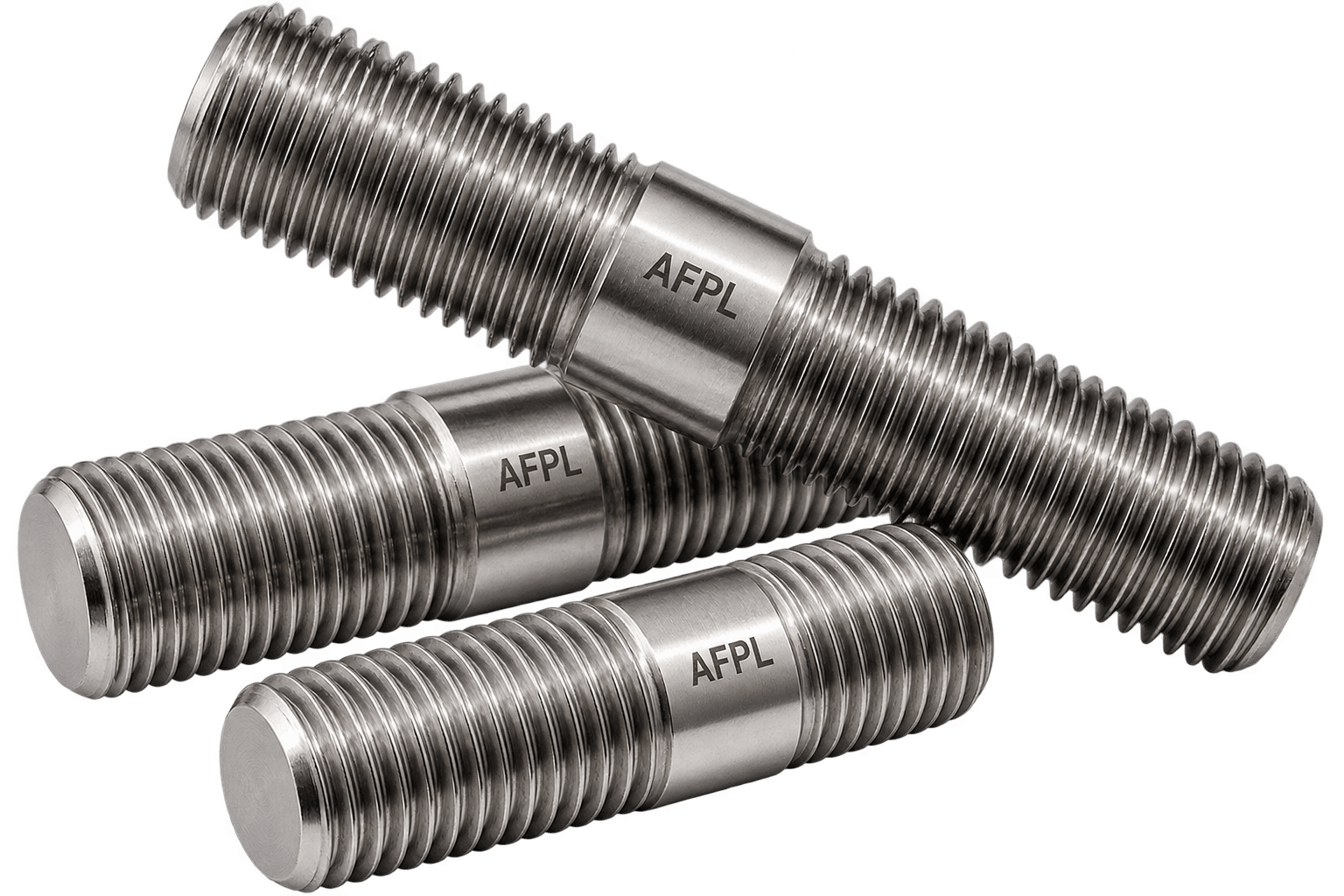
Flange Stud Bolts are fully threaded studs with no tap end, passing completely through aligned clearance holes in two mating flanges, with a nut threaded onto each end. This is genuinely symmetric — unlike a tap-end double end stud, neither end is permanently engaged into either flange.
Here is why this matters. Because there’s no permanent engagement anywhere along the stud’s length, the entire clamping preload that compresses the gasket between the two flange faces is carried purely by the stud’s own tensile elongation between the two nuts. This means uniform elongation is what maintains gasket compression, and because a flanged joint typically uses many studs around the bolt circle, achieving uniform elongation, and thus even gasket compression, across all of them requires a specific cross-pattern or star-pattern tightening sequence — tightening opposite or diagonal studs incrementally rather than sequentially around the circle. Tightening sequentially around the circle in a normal single pass causes uneven gasket compression, since each new stud’s tightening slightly relaxes its neighbors, genuinely risking leak paths at the under-compressed points even if every individual stud reaches its correct final torque.
A genuine, honest limitation is worth stating plainly. Correct torque sequence alone doesn’t guarantee even compression if the studs themselves have different effective lengths, thread conditions, or lubrication. Inconsistent friction between studs — some lubricated, some dry, some corroded — causes the same applied torque to produce different actual preload and elongation in each stud, undermining the cross-pattern sequence’s intended uniformity. Buyers should confirm that stud lubrication and friction condition is consistent across the full set, not just rely on correct tightening sequence and the same nominal torque value, to genuinely achieve even gasket compression.
Akbar Fasteners Pvt. Ltd. exports to over 50 countries, and our flange stud bolt range is manufactured and verified for thread and mechanical property consistency across every set under our ISO 9001:2015 quality system.
A Note on Confirming Stud Lubrication & Consistency Across the Full Set
Please confirm your lubrication practice and torque sequence plan when requesting a quote — consistent friction across every stud in the set genuinely matters as much as the tightening pattern itself.
Where This Product Genuinely Applies
Genuine Set Consistency Verification
We verify thread and length consistency genuinely across every stud in the set.
Tightening Sequence Guidance
We advise honestly on cross-pattern torque sequence for your bolt circle.
Lubrication Consistency Confirmation
We confirm friction condition genuinely before recommending a torque value.
Verified Dimensions & Mechanicals
Batch testing confirms genuine thread and tensile compliance for every lot.
Flange Stud Bolts vs Double End Stud Bolts — Quick Reference
Confirming whether your joint genuinely passes through two mating flanges with clearance holes, or terminates in one flange’s own tapped hole instead. This table is the quick reference we use with buyers before quoting.
| Aspect | Flange Stud Bolts | Double End Stud Bolts |
|---|---|---|
| End Configuration | Genuinely symmetric — no tap end | Genuinely asymmetric — one tap end, permanent |
| Preload Source | Genuinely pure stud elongation between two nuts | Genuinely tap end engagement plus nut-end clamp |
| Critical Installation Factor | Genuinely cross-pattern torque sequence | Genuinely tap end installation torque |
Flange Stud Bolt Specification Details
Grades We Supply
- Carbon Steel A193 B7, A320 L7
- Stainless Steel A193 B8, B8M
- Alloy Steel B16, Hastelloy, Inconel
- Coating PTFE, Xylan, Zinc
What We Need
- Flange Bolt Circle & Stud Count Required
- Gasket Type & Sealing Requirement Required
- Lubrication/Coating Preference Confirm on Enquiry
- Order Quantity & Form Per Order
Quality Practice
- Thread Gauge Inspection Every Lot
- Length/Batch Consistency Check Every Set
- Tensile/Proof Load Testing Every Lot
- NABL Testing Available on Request
Application Areas
Wherever two mating flanges genuinely need even, reliable gasket compression across the full bolt circle.
Pipe-to-Pipe Flanged Joints
across the complete bolt circle
High-Pressure Process Piping
critical for leak-free sealed joints
Refinery & Petrochemical Flange Bolting
for large multi-stud bolt circles
General Flange-to-Flange Bolting Needs
a through-bolted flanged joint is genuinely required
Standard Export Documentation
Prepared as standard practice for every flange stud bolt shipment.
Mill Test Certificate (MTC)
Material composition and mechanical property verification for every heat.
Set Consistency Report
Confirms genuine length and thread uniformity across the complete stud set.
Certificate of Conformance
Confirms the shipment matches the purchase order specification in full.
Certificate of Origin (COO)
Confirms India as country of manufacture for destination customs purposes.
NABL Accredited Test Reports
Independent mechanical and dimensional testing available on request.
Commercial Invoice & Packing List
Itemized value, Incoterm, and detailed carton/weight breakdown for customs clearance.
Internationally Recognised Standards Coverage
Related Products & Materials
Double End Stud Bolts
Our tap-end stud range, for joints terminating in a permanently engaged tapped hole.
View Double End Stud Bolts →Weldoflanges
Our weld neck flange range, commonly bolted with flange stud bolts.
View Weldoflanges →Hex Nuts
Our standard nut range, used at both ends of every flange stud bolt.
View Hex Nuts →Stainless Steel Fasteners Manufacturer India
Our broader manufacturing capability across all major carbon, alloy, and stainless grades.
View SS Manufacturer Guide →Tell Us Your
Bolt Circle & Sealing Requirement
Share your flange bolt circle, stud count, and gasket type — we’ll confirm the correct stud set and quote with full documentation. Akbar Fasteners Pvt. Ltd. responds within 24 hours.
Sales: +91 724 0000 733 · Support: +91 800 9315 333 · sales@akbarfasteners.in