Nylock Nuts
Manufacturer
India · Mumbai
Anatomy of a Nylock Nut — Interference Fit, Not Adhesion
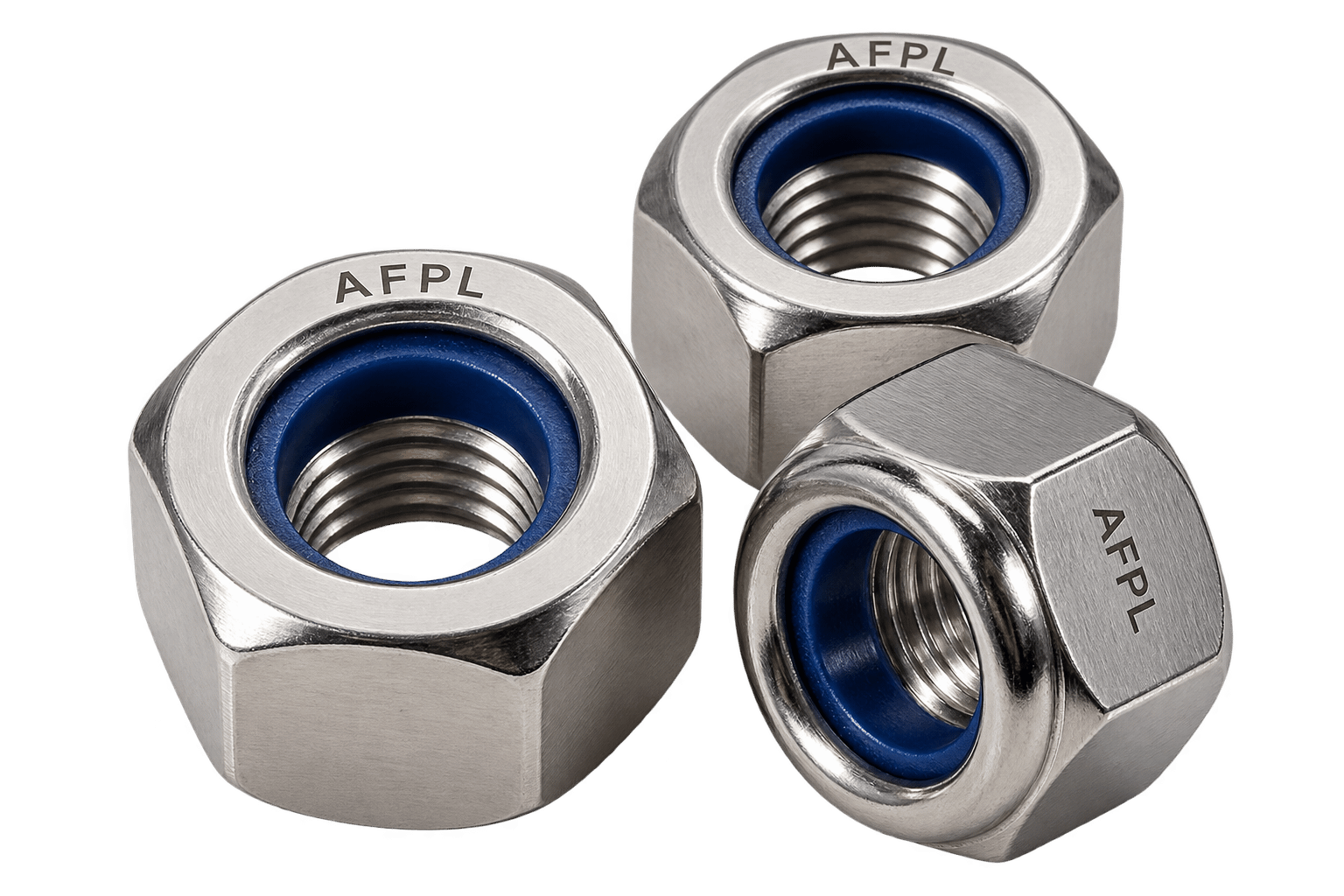
A Nylock nuts manufacturer India is a standard hex nut with a ring of nylon (typically nylon 6/6) moulded or pressed into a recessed groove at one end of the thread bore. The critical dimension is that the nylon ring’s internal diameter, before the bolt is ever inserted, is deliberately smaller than the bolt’s major thread diameter — the nylon physically occupies space the bolt’s threads need to pass through.
As the bolt is threaded up through the nut and reaches the nylon section, the harder steel thread cuts its own path through the softer nylon, displacing and compressing the nylon material radially outward around the thread form. This creates a genuine interference fit — the compressed nylon exerts continuous inward radial pressure against the bolt’s thread flanks along the entire length of nylon engagement, generating friction that resists back-rotation. This is fundamentally different from an adhesive or chemical bond: the nylon never sticks to the bolt in any chemical sense — the locking action is purely mechanical, a spring-like compression force maintained by the elastic memory of the nylon material itself.
This is the identical underlying principle used across every nylon-based lock nut we manufacture — our full-height nylock nut here, the reduced-height nylock jam nut, and the nylon variant of our 2-way lock nut range. What varies between these products is body height and insert placement — never the fundamental interference-fit compression mechanism described here.
Why Nylock Nuts — Simple, Proven, and Genuinely Economical
The Simplest Possible Prevailing-Torque Mechanism
Compared with our all-metal distorted-thread range or K-Lock’s dual spring-and-serration design, a nylon insert nut has a single, easily understood locking principle — a compressed ring of nylon gripping the thread. This simplicity translates directly into lower manufacturing cost and the lowest unit price of any prevailing-torque lock nut in our range.
Universally Recognised, Zero Special Tooling
A nylock nut is installed and removed with exactly the same wrench or socket as any standard hex nut — no special installation knowledge, no orientation-sensitive assembly step beyond standard practice, and immediate recognition by any technician anywhere in the world who has ever worked with fasteners.
Genuinely Reusable a Limited Number of Times
Unlike a one-time-use adhesive thread locker, a nylock nut’s nylon insert retains meaningful locking capability across several reinstallation cycles as long as the insert isn’t visibly damaged or excessively worn — a practical, field-verifiable reusability that doesn’t require special test equipment to assess before reuse.
Visual, Tactile Confirmation During Installation
An installer can feel the distinct increase in turning resistance as the bolt engages the nylon insert — clear tactile feedback that the locking feature is actually being engaged, rather than a hidden internal mechanism whose engagement cannot be directly sensed during assembly.
Temperature, Chemistry, and Long-Term Storage — What Actually Limits Nylon
Temperature is the most commonly cited limit, and correctly so — continuous service above roughly 120°C progressively softens the nylon, reducing the compressive interference force it can maintain against the bolt thread, until the locking function is effectively lost. This is a gradual degradation, not a sudden failure point, but the practical guidance remains: for anything approaching or exceeding 100–120°C continuous service, specify an all-metal alternative rather than a nylon insert.
Chemical exposure is a less commonly discussed but equally real limitation. Nylon 6/6 has good general resistance to oils, greases, and many common solvents, but is genuinely attacked or softened by strong acids, certain ketones (such as MEK), and some chlorinated solvents — a specific chemical compatibility check against the actual process fluid or cleaning agent present is worthwhile wherever a nylock nut will see direct exposure, rather than assuming general “chemical resistance” covers every specific fluid.
Long-term moisture absorption is a third, more subtle factor: nylon is hygroscopic, meaning it absorbs a small amount of atmospheric moisture over time, particularly in humid storage or service environments. This absorbed moisture can very slightly plasticise the nylon, marginally softening it compared to a completely dry sample — a minor effect for most practical purposes, but worth noting for extended-storage inventory or humid coastal environments where the cumulative effect over years, combined with elevated ambient temperature, can compound the base temperature limitation somewhat faster than a temperature rating alone would suggest.
Nylock Nut Material & Finish Options
The nylon insert itself is the same nylon 6/6 material across all base metal grades — selection follows the application’s mechanical and corrosion requirement.
Nylock Nut Configurations
Standard full-height hex nylock nuts across the complete material range, plus matched washers. M3–M36.
Standard Nylock Nut
Full-height hex body, nylon insert per DIN 982. M3–M36. The default general-purpose vibration-resistant nut across automotive, machinery, and general fastening applications.
Flanged Nylock Nut
Nylon insert combined with an integral bearing flange per DIN 6926 — for applications benefiting from both nylon locking and eliminating a separate washer in one part.
Matching Flat Washers
Plain flat washers matched to nylock nut thread size and grade for applications requiring additional bearing area distribution beneath the nut face.
Custom Nylock Nuts
Non-standard sizes, inch UNC/UNF thread, and drawing-specific configurations in any available material. Contact sales@akbarfasteners.in with thread size, grade, and quantity.
Complete Lock Nut Family Comparison
This nylock nut is the foundation design for two other products in our range, and a direct alternative to two more. Use this table to navigate to the correct page for your specific requirement.
| Product | Mechanism | Max Temp. | Height | Orientation | Notes |
|---|---|---|---|---|---|
| Nylock Nut This Page | Nylon interference fit | ~120°C | Full | Directional | Lowest cost, most familiar |
| Nylock Jam Nut | Nylon interference fit | ~120°C | Thin / Jam | Directional | Compact adjustable linkages |
| 2-Way Lock Nut (Nylon) | Nylon, both faces | ~120°C | Full | Symmetric | Eliminates orientation error |
| All-Metal Lock Nut | Distorted thread | Base metal | Full | Directional | High-temp, chemical-resistant |
| K-Lock Nut | Spring + serration | Base metal | Full | Directional | Dual mechanism, best reuse |
Nylock Nut Size Chart — M3 to M36
Across-flats dimension and overall height for the standard full-height nylock nut.
| Thread Size | Across Flats (mm) | Height (mm) |
|---|---|---|
| M3 | 5.5 | 5.0 |
| M4 | 7.0 | 6.0 |
| M5 | 8.0 | 7.0 |
| M6 | 10.0 | 8.0 |
| M8 | 13.0 | 9.5 |
| M10 | 17.0 | 11.5 |
| M16 | 24.0 | 18.5 |
| M24 | 36.0 | 26.5 |
Nylock Nuts Application Areas
General machinery, automotive, and any ambient-temperature vibration-resistant connection where cost and universal familiarity matter.
General Automotive Assembly
ambient-temp connections
General Machinery
equipment mounting
General Vibrating Equipment
ambient-duty vibration resist.
Appliance Manufacturing
general fastening schedule
General Fabrication
custom equipment fabrication
Furniture & Fixtures
ambient-temp fastening
Material Handling
general vibration duty
Agricultural Equipment
tractor and machinery bolts
Nylock Nut Standards Coverage
Same ISO 9001:2015 quality system as our complete fastener range. Insert dimension and prevailing torque verified against DIN 982 on every production lot.
Complete Documentation Package
Grade / Standard Stated
Proof Load · Hardness
ISO 2320 (on request)
Conformance
On Request
Related Nut Types & Materials
Nylock nuts for standard general-purpose vibration resistance. Related specialty variants and all-metal alternatives for specific requirements beyond nylon’s temperature and chemical range.
Nylock Jam Nuts
The reduced-height variant of this same nylon locking principle — for clearance-limited adjustable linkages, turnbuckles, and rod ends where full-height doesn’t fit.
View Nylock Jam Nuts →2-Way Lock Nuts
The orientation-free adaptation of this nylon locking principle — for high-volume assembly and field service where installation-error prevention matters.
View 2-Way Lock Nuts →All-Metal Lock Nuts
The high-temperature, chemical-resistant alternative where nylon’s ~120°C ceiling is unsuitable — full metallic locking with no polymer component.
View All-Metal Lock Nuts →K-Lock Nuts
The dual-mechanism all-metal alternative offering more consistent multi-cycle reuse performance than either nylon or distorted-thread designs alone.
View K-Lock Nuts →Need Nylock
Nuts?
Thread size · grade · finish · quantity. Akbar Fasteners Pvt. Ltd. responds within 24 hours.
Export: +91 8696 32 4646 · Support: +91 800 9315 333 · export@akbarfasteners.in