Shoulder Bolts
Manufacturer
India · Mumbai
Anatomy of a Shoulder Bolt — The Ground Shoulder Is the Product
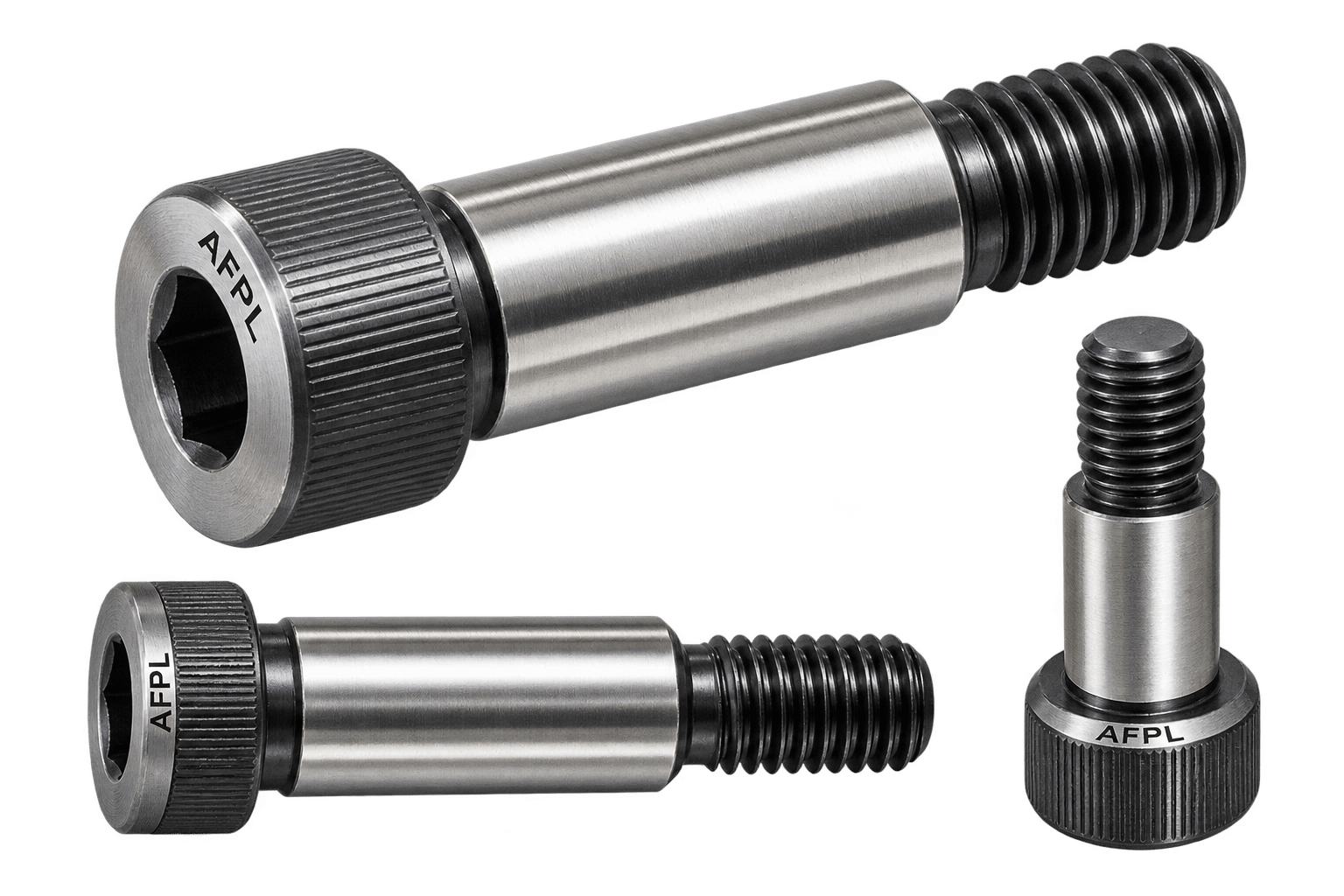
A Shoulder bolts manufacturer India has three distinct sections, each with a different diameter and a different job: a socket or hex drive head; a precision-ground cylindrical shoulder immediately below the head, machined to a tight tolerance (commonly h9); and a smaller-diameter threaded section at the tip. On a standard bolt, the shank between head and thread is simply whatever diameter is convenient to manufacture — it is never intended to be a precision bearing surface, and its diameter is rarely toleranced any more tightly than the thread itself.
On a shoulder bolt, the relationship is inverted: the shoulder diameter is the functionally important dimension, precision-ground to a specific size and roundness tolerance so that a rotating bushing, bearing, roller, cam follower, or pivoting linkage arm can be mounted directly onto it and rotate freely and smoothly — the shoulder itself functions as a ground axle or pivot pin. The threaded end exists purely to draw the bolt into a tapped hole and hold the shoulder at a fixed, repeatable position and orientation; it plays no role in the bearing function at all.
This is why shoulder length is also a critical, independently specified dimension — it is sized to precisely match the thickness of the rotating component (plus any bushing or spacer) that will pivot on it, so that when the bolt is fully tightened, the rotating part is clamped snugly between the underside of the head and the top of the threaded shoulder step, free to rotate without axial play, but without being crushed or bound by excessive clamping force on the pivoting element itself. Getting this length correct is what makes a shoulder bolt work as a precision machine element rather than just an oddly-shaped fastener.
Why Shoulder Bolts — A Precision Axle That Also Fastens Itself
Precision Bearing Surface Without a Separate Machined Pin
Before shoulder bolts, a designer needing a pivot point had to specify a separate ground dowel pin or axle, held in place by a retaining ring, cross-pin, or press fit — an additional component and assembly step. A shoulder bolt combines the precision bearing surface and the retention/clamping function into a single off-the-shelf part, installed with a single wrench or Allen key operation.
Consistent, Repeatable Bearing Diameter Across Every Part
Because the shoulder diameter is precision-ground to a tight tolerance (commonly h9) as a controlled manufacturing process, every shoulder bolt in a production batch presents an identical bearing surface diameter to the rotating component — critical for interchangeable assembly, consistent rotational friction, and predictable wear behaviour in high-cycle applications like cam followers and indexing mechanisms.
Correctly Sized Shoulder Length Prevents Bind or Play
The shoulder length is specified to precisely match the thickness of the rotating component stack — too short and the head clamps directly onto the rotating part, binding it against rotation; too long and the rotating part has axial play, introducing wobble and uneven wear. Because shoulder length is a controlled dimension across a standard part range, designers can select the correct length directly from a catalogue rather than machining a custom pin for every application.
Case-Hardened Wear Resistance at the Bearing Surface
Carbon steel shoulder bolts are typically case-hardened specifically at the shoulder surface — providing a hard, wear-resistant bearing surface for the rotating component to ride on, while retaining a tougher, more ductile core to resist the fastener from becoming brittle under clamping and shock load. This surface-hardened-core-tough combination is a deliberate metallurgical choice specific to the shoulder bolt’s dual bearing-and-fastener role.
Shoulder Bolt vs Standard Bolt vs Separate Dowel Pin
Each solves the “I need something to rotate on” problem differently — with different part counts, tolerances, and assembly steps.
Shoulder Bolt
Ground, toleranced shoulder diameter combined with a smaller clamping thread in one part. Single component, single installation step, precision bearing surface guaranteed by manufacture.
Standard Hex / Socket Bolt
Shank diameter is a manufacturing convenience, not a controlled bearing tolerance — using a standard bolt as a pivot point results in inconsistent rotational fit, accelerated wear, and unpredictable play between parts.
Dowel Pin + Retaining Ring
A precision ground dowel pin provides an equally good (often better toleranced) bearing surface, but requires a separate retention method — a retaining ring, cross-drilled pin, or press fit into a housing — adding parts and assembly steps compared with a shoulder bolt’s self-contained clamp-and-retain design.
Shoulder Bolt Material & Hardness Options
Case-hardened carbon steel is the standard grade for wear-resistant bearing applications; stainless for corrosive or wash-down environments.
Shoulder Bolt Configurations & Related Precision Hardware
Standard socket head shoulder bolts across the common shoulder diameter range, plus matching bushings and retaining hardware. M4–M24.
Standard Shoulder Bolt
Hex socket head, precision ground shoulder, smaller threaded end. M4–M24 shoulder diameter. The primary configuration for cam followers, pivoting linkages, and general precision bearing/pivot applications across jigs, fixtures, and machinery.
Hex Head Shoulder Bolt
External hex head variant of the standard shoulder bolt per DIN 7379, for applications requiring wrench installation rather than a hex socket key — same precision ground shoulder and threaded end specification.
Matching Bushings & Rollers
Precision-bored bushings and cam roller bodies sized to match shoulder bolt diameters, completing a full pivot assembly. Bronze, nylon, and hardened steel bushing options available depending on load and rotational speed requirement.
Custom Shoulder Bolts
Non-standard shoulder diameters, custom shoulder-to-thread length ratios, and drawing-specific tolerance classes for proprietary pivot and linkage applications. Contact sales@akbarfasteners.in with shoulder diameter, shoulder length, thread size, and tolerance requirement.
Shoulder Bolt Size Chart — Shoulder Ø 4mm to 24mm
Standard shoulder diameter and the smaller matched thread size per ASME B18.3 — note the thread is always one or two sizes smaller than the shoulder, never equal to it.
| Shoulder Ø (mm) | Matched Thread | Fit Tolerance | Typical Application |
|---|---|---|---|
| 4mm | M3 | h9 | Small instrument pivots |
| 5mm | M4 | h9 | Precision linkage pivots |
| 6mm | M5 | h9 | General jig & fixture pivots |
| 8mm | M6 | h9 | Cam follower axles |
| 10mm | M8 | h9 | Medium-load rollers |
| 12mm | M10 | h9 | Heavier linkage arms |
| 16mm | M12 | h9 | Industrial cam followers |
| 20mm | M16 | h9 | Heavy-duty pivot assemblies |
Shoulder Bolts Application Areas
Jigs and fixtures, robotics, packaging machinery, and any mechanism requiring a precision pivot or rotating bearing surface.
Cam Followers
indexing table followers
Jigs & Fixtures
swing-clamp mechanisms
Robotics & Automation
gripper mechanism axles
Packaging Machinery
indexing mechanism pivots
Die Sets & Stamping
die guide pivot points
Material Handling
swing gate pivot points
Textile Machinery
tensioning arm axles
Instrumentation
SS 316L instrument arms
Shoulder Bolt Standards Coverage
Same ISO 9001:2015 quality system as our complete fastener range. Shoulder diameter, roundness, and shoulder length verified against ASME B18.3 / DIN 7379 tolerance on every production lot.
Complete Documentation Package
Material / Grade Stated
Shoulder Ø · Length · Round.
Surface + Core Reading
Conformance
On Request
Related Bolt Types & Materials
Shoulder bolts for precision pivot and bearing applications. Full bolt range for the complete fastening schedule. SS 316L for corrosive or wash-down environments.
Full Bolt Range
Complete bolt manufacturing capability at Akbar Fasteners — shoulder bolts, hex, flange, carriage, socket, hollow, and all specialty head forms across carbon steel through exotic alloy, all from a single Mumbai facility.
View Bolt Range →Hex Flange Bolts
For standard mechanical clamping applications where no rotating or pivoting element is involved — the integral washer flange serves a purely clamping function, contrasted with the shoulder bolt’s precision bearing role.
View Flange Bolts →SS 316L Fasteners
For shoulder bolt applications in food-grade, pharmaceutical, or corrosive-environment machinery where carbon steel’s corrosion resistance is insufficient — SS 316L shoulder bolts for wash-down pivot points and instrument linkages.
View SS 316L →Carbon Steel Fasteners
For the case-hardened and through-hardened carbon and alloy steel grades used in shoulder bolt manufacture — wear-resistant surface hardness combined with tough core properties for reliable pivot and bearing performance.
View Carbon Steel →Need Shoulder
Bolts?
Shoulder diameter · shoulder length · thread size · material grade · tolerance class. Akbar Fasteners Pvt. Ltd. responds within 24 hours.
Export: +91 8696 32 4646 · Support: +91 800 9315 333 · export@akbarfasteners.in