Weld Square Nuts
Manufacturer
India · Mumbai
Anatomy of a Weld square nuts manufacturer India — Projections, Pilot Pins, and a Genuine Metallurgical Bond
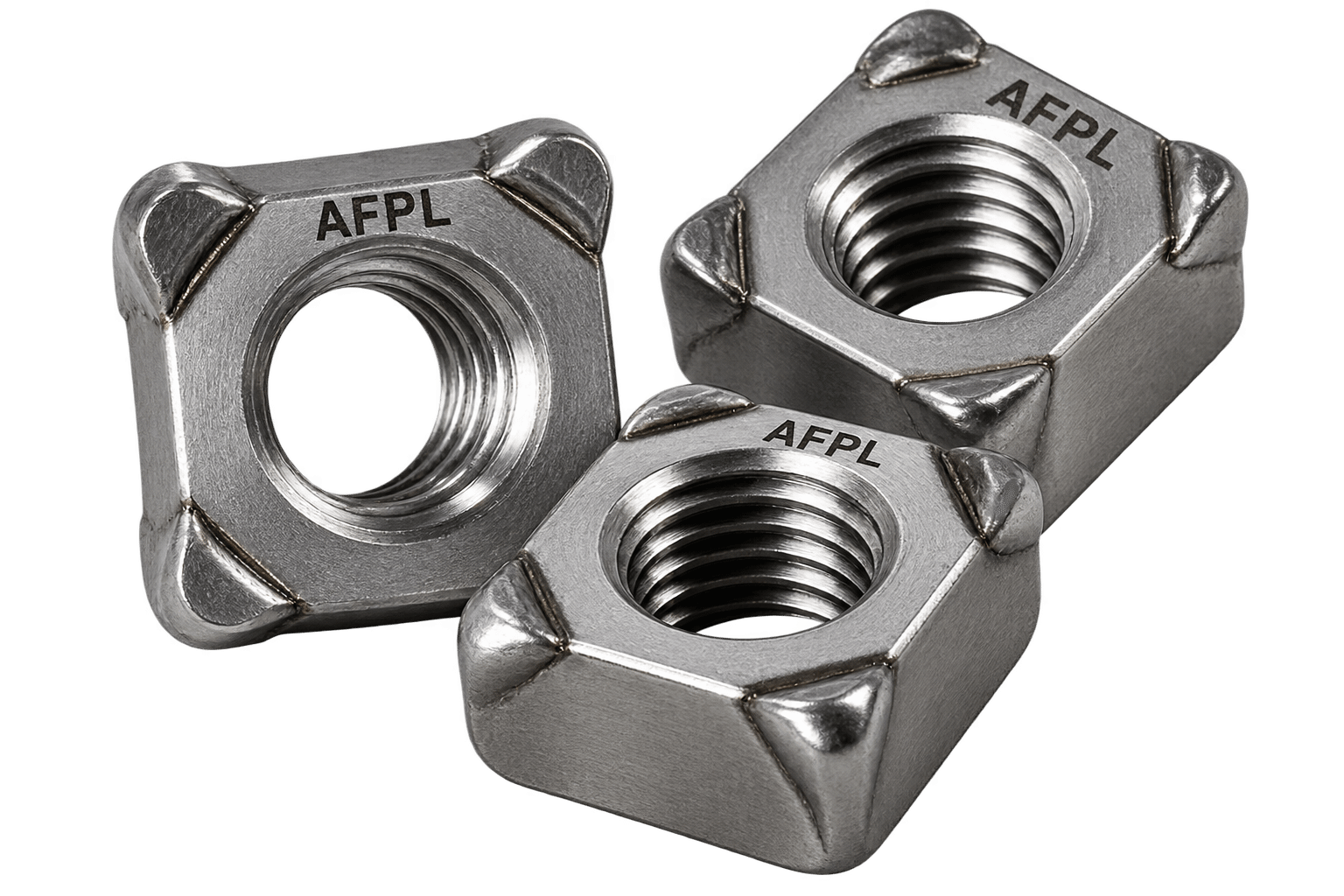
A Weld square nuts manufacturer India looks like an ordinary square nut but has two features invisible on a standard nut: small raised weld projections (also called nibs or bumps) cast or forged onto the underside bearing face, and — on most designs — three or four pilot pins extending slightly below the projections. Neither feature is decorative; both exist purely to control the resistance welding process that permanently attaches the nut to a sheet metal panel.
During resistance projection welding, the nut is positioned on the sheet metal panel with its pilot pins engaging matching small holes pre-punched in the panel — these pins do the same job for the welding process that a locating dowel does for machine assembly, holding the nut in exact position and orientation before any current flows. A welding electrode then clamps the nut against the panel and passes a very high electrical current for a fraction of a second. Because the weld projections are the only points of physical contact between nut and panel, nearly all of the current — and therefore nearly all of the resistive heating — is concentrated at those small projection points rather than spread across the full bearing face.
The projections heat to melting point in milliseconds, and the clamping force of the welding electrode collapses them flat into the panel surface as they melt — creating a fused nugget of metal that is, metallurgically, no longer “nut” and “panel” as two separate pieces, but one continuous piece of steel with a threaded hole in it. This is fundamentally different from every mechanically-retained nut in our range — a T-slot nut, a square thin nut, or a K-Lock nut can all be removed; a correctly welded weld nut cannot be removed without destroying the weld and very likely damaging the panel.
Why Weld Square Nuts — Solving the No-Backside-Access Problem Permanently
Eliminates the Backside Access Problem Entirely
Every mechanically-retained nut on our site — square thin nuts, T-slot nuts, standard hex nuts — requires some form of access to the far side of the joint, whether to hold the nut against rotation or to physically insert it into a slot before assembly. Once a sheet metal enclosure or automotive body panel is closed up, welded, or otherwise sealed, that backside access disappears forever. A weld nut is attached before the panel is closed, at the fabrication stage, permanently solving the access problem before it ever becomes one.
No Loosening — There Is No Mechanical Joint to Loosen
A mechanically retained nut, however well designed, is still two separate pieces held together by friction, spring force, or geometric interlock — all of which can theoretically be defeated by extreme vibration, impact, or thermal cycling over enough time. A projection-welded nut has no such joint; the nut and panel are one continuous piece of metal at the weld nugget. There is nothing to loosen because there is no longer a mechanical connection at all.
Automated High-Volume Production Compatibility
Resistance projection welding is fully compatible with automated robotic welding cells used in automotive body-in-white assembly and high-volume appliance manufacturing — the pilot pins allow robotic pick-and-place systems to position the nut accurately without a human operator manually threading it into place, and the weld cycle itself takes a fraction of a second. This makes weld nuts the standard fastening solution wherever assembly line speed and consistency matter as much as joint strength.
Consistent, Precisely Located Threaded Points Every Time
Because the pilot pins engage pre-punched locating holes in the panel, every weld nut lands in exactly the same position relative to the panel’s other features, weld after weld, across an entire production run. This positional consistency is difficult to achieve with a mechanically-fitted nut that must be manually aligned by an assembler, making weld nuts the preferred solution for high-precision sheet metal assemblies with tight tolerance stack-ups.
Permanent Weld Nuts vs Mechanically Retained Slot-Fit Nuts
Every other nut in our range is mechanically retained and removable in principle. Weld nuts are permanent by design — this is the single most important distinction for correct specification.
Weld Square Nut
Fused to the panel via resistance projection welding before final assembly. Not removable without destroying the weld and likely damaging the panel. Correct for locations that become inaccessible once the assembly is closed or sealed.
Square Thin Nut (Slot-Fit)
Mechanically captured in a rectangular slot or channel — anti-rotation only, fully removable by sliding out of the slot. Correct where the assembly will be opened again for maintenance, adjustment, or replacement.
T-Slot Nut (Undercut Slot-Fit)
Mechanically captured in a T-shaped undercut slot — resists pull-out via the undercut geometry, but still fully removable by sliding out along the slot length. Correct for workholding fixtures that are set up and struck down repeatedly.
Weld Square Nut Material & Weldability Options
Material selection must consider weldability to the specific panel steel grade, not just the nut’s own mechanical properties — a critical difference from mechanically-retained nut selection.
Weld Nut Configurations
Square and hex weld nut body shapes with matching pilot pin and projection configurations. M4–M20.
Square Weld Nut
Square body with three or four weld projections and pilot pins on the bearing face per DIN 928. M4–M20. The primary configuration for automotive body panel fastening and general sheet metal fabrication where a square profile is specified.
Hex Weld Nut
Hexagonal body with matching weld projections and pilot pins per DIN 929. M4–M20. Used where a hexagonal profile is preferred for identification, visual inspection, or where the application drawing specifically calls for hex rather than square geometry.
Round Weld Nut
Round body variant for applications where a non-square, non-hex profile is preferred for clearance or aesthetic reasons — retains the same weld projection and pilot pin functionality as square and hex variants.
Custom Weld Nuts
Non-standard body shapes, custom pilot pin count and spacing, and drawing-specific weld projection configurations for proprietary automotive or appliance fixturing. Contact sales@akbarfasteners.in with thread size, panel steel grade, and pilot pin spacing requirement.
Weld Nut Size Chart — M4 to M20
Across-flats dimension and typical pilot pin count/spacing for each thread size. Pilot hole layout in the panel must match the specific pin spacing before welding.
| Thread Size | Across Flats (mm) | Pilot Pins | Typical Panel Thickness |
|---|---|---|---|
| M4 | 7.0 | 3 | 0.8–1.5mm |
| M5 | 8.0 | 3 | 0.8–2.0mm |
| M6 | 10.0 | 3–4 | 1.0–2.5mm |
| M8 | 13.0 | 4 | 1.5–3.0mm |
| M10 | 17.0 | 4 | 2.0–4.0mm |
| M12 | 19.0 | 4 | 2.5–5.0mm |
| M16 | 24.0 | 4 | 3.0–6.0mm |
| M20 | 30.0 | 4 | 4.0–8.0mm |
Panel thickness ranges are general guidance — always confirm against welding equipment capacity and a qualified weld schedule for the specific panel material.
Weld Square Nuts Application Areas
Automotive body assembly, appliance manufacturing, HVAC ductwork, and general sheet metal fabrication — wherever a threaded point must be permanently built into a panel before final assembly seals off backside access.
Automotive Body-in-White
robotic weld cell production
Appliance Manufacturing
refrigerator body fastening
HVAC Ductwork
equipment housing fastening
Electrical Enclosures
sealed cabinet fastening
Two-Wheeler / Motorcycle
fairing mounting points
Machine Guarding & Covers
equipment panel threading
Rail & Transport Bodies
interior fitting mount points
General Sheet Metal Fab
custom enclosure fabrication
Weld Nut Standards Coverage
Same ISO 9001:2015 quality system as our complete fastener range. Weld projection height, pilot pin dimension, and body geometry verified against DIN 928/929 on every production lot.
Complete Documentation Package
Material / Grade Stated
Projection Ht. · Pin Spacing
Conformance
(On Request)
On Request
Related Nut Types & Materials
Weld nuts for permanent sheet metal fastening. Square thin nuts and T-slot nuts for removable slot-fit applications. SS 316L for stainless sheet fabrication and corrosive environments.
Square Thin Nuts
For serviceable slot-fit applications where future access is required — the removable alternative to a weld nut when the assembly will be opened again for maintenance or adjustment.
View Square Thin Nuts →T-Slot Nuts
For precision machine table workholding requiring repositionable, removable clamping — a fundamentally different application from weld nuts’ permanent sheet metal fastening role.
View T-Slot Nuts →Full Nut Range
Complete nut manufacturing capability at Akbar Fasteners — hex nuts, heavy hex, square, K-Lock, T-slot, weld nuts, and all specialty nut forms across carbon steel through exotic alloy, all from a single Mumbai facility.
View Nut Range →SS 316L Fasteners
For weld nut applications in stainless sheet metal fabrication, food-grade equipment, or corrosive-environment enclosures where carbon steel weldability is insufficient for the panel material.
View SS 316L →Need Weld Square
Nuts?
Thread size · body shape (square/hex) · panel steel grade · quantity. Akbar Fasteners Pvt. Ltd. responds within 24 hours.
Export: +91 8696 32 4646 · Support: +91 800 9315 333 · export@akbarfasteners.in