Square Thin Nuts
Manufacturer
India · Mumbai
Anatomy of a Square thin nuts manufacturer India — Shape Prevents Rotation, Height Saves Clearance
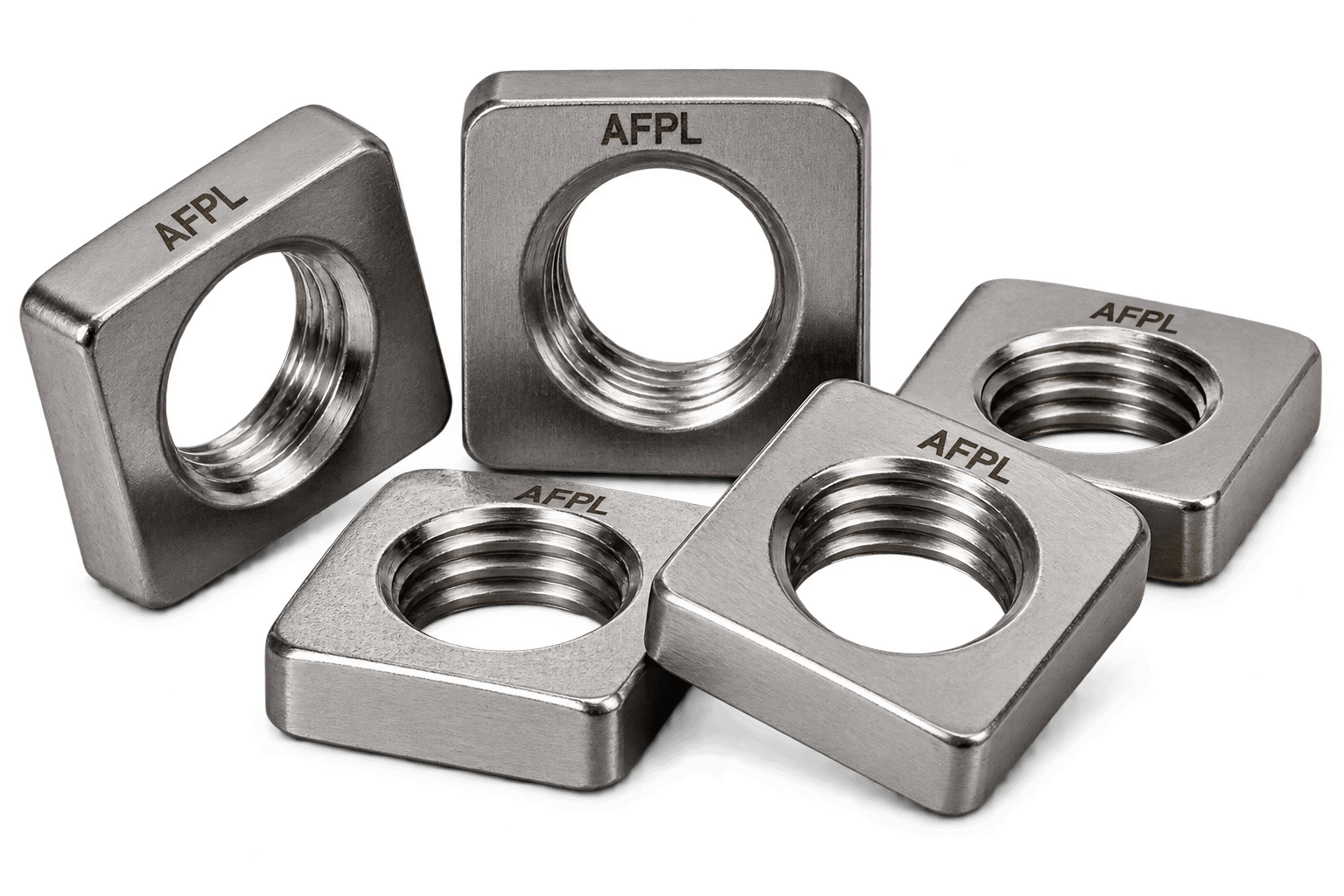
A square thin nut combines two independent geometric decisions in a single fastener: a four-sided square body instead of the standard six-sided hexagon, and a reduced height compared with a full-height nut of the same thread size. Each decision solves a completely different installation problem, and either can be specified without the other — a square nut can be full-height, and a thin nut can be hexagonal.
The square shape’s purpose is anti-rotation, not wrenching. A hex nut’s six flats give a wrench six possible gripping angles — useful when a spanner must be applied to hold the nut still. A square nut’s four flats serve a different function entirely: when a square nut sits in a matching square-profile slot, channel, or recess (common in sheet metal enclosures, T-slot extrusion systems, and electrical panel fittings), the flat sides of the square body contact the flat sides of the slot and physically prevent the nut from spinning when the bolt is tightened from the opposite, often inaccessible, side. No wrench is needed to hold a correctly slotted square nut in place — the slot itself does the holding.
The thin profile’s purpose is axial clearance, independent of the anti-rotation function. A standard full-height nut may simply be too tall to fit within the available depth behind a panel, inside an enclosure, or within a stack of components sharing a single bolt length. DIN 562 defines the thin-profile square nut specifically for these clearance-limited assemblies — trading some thread engagement length (and therefore some maximum load capacity) for a significantly reduced overall height. Where full load capacity matters more than clearance, DIN 557’s full-height square nut retains the anti-rotation slot-fit benefit without the load-capacity trade-off of the thin version.
Why Square Thin Nuts — Two Problems, One Fastener
No Access Required to Hold the Nut Steady
In sheet metal enclosures, electrical panel backs, and machine covers, the nut side of a connection is frequently completely inaccessible once assembly begins — behind a panel, inside a sealed housing, or in a slot cut specifically to capture the nut before the panel is closed. A square nut seated in a matching square slot cannot rotate as the bolt is driven from the accessible side, eliminating the need for a second technician or a specialty tool to hold the nut in place.
Purpose-Built for T-Slot and Channel Systems
Aluminium T-slot extrusion framing systems, DIN rail electrical mounting, and machine slide channels are frequently manufactured with a rectangular slot cross-section specifically sized to accept a square nut. The square nut drops into the slot before assembly and is captured by the channel walls, sliding to the correct position along the slot length before the bolt is tightened — a positioning method that a round or hex nut cannot replicate.
Thin Profile Solves Stack-Height and Enclosure Depth Limits
Where the available depth behind a panel or within an enclosure is limited — often to just a few millimetres beyond what a standard bolt and full nut would require — DIN 562’s thin profile reclaims that clearance while retaining full thread diameter. This is common in electronics enclosures, thin sheet metal assemblies, and any application where the fastener stack height is a hard design constraint rather than a preference.
Lower Material Cost at High Production Volumes
A thin square nut uses measurably less raw material per piece than an equivalent full-height hex nut — a small per-unit saving that becomes significant at the production volumes typical of electrical hardware, appliance manufacturing, and general sheet metal fabrication. Where the application’s load requirement is genuinely satisfied by the reduced thread engagement of a thin nut, specifying it over a full-height alternative is a straightforward cost optimisation.
DIN 562 vs DIN 557 vs Hex Thin Nuts — Selection Guide
Shape and height are independent variables — this guide separates the two decisions so the correct combination is specified for the actual installation constraint.
DIN 562 Thin Square Nut
Square body, reduced height. Combines anti-rotation slot-fit with minimum axial clearance requirement. The correct choice when both the rotation-prevention benefit of a square body AND a restricted installation depth apply simultaneously.
DIN 557 Full Square Nut
Square body, full standard height with complete thread engagement. Retains the anti-rotation slot-fit benefit of the square shape without the reduced load capacity trade-off of the thin profile — the correct choice when clearance is not restricted but the anti-rotation benefit is still needed.
Hex Thin Nut (Jam Nut)
Standard hexagonal body, reduced height — commonly called a jam nut. Provides clearance savings identical to DIN 562, but the hex shape offers no anti-rotation slot-fit benefit; a wrench is needed to hold this nut still during tightening, or it is used as a locking jam nut against a second full nut.
Square Thin Nut Material & Strength Options
Standard carbon steel Grade 4 for general use; stainless for corrosion resistance; brass for electrical and non-sparking applications.
Square Thin Nut Configurations
Both DIN 562 and DIN 557 profiles across the full material range, plus matched washers. M4–M24.
Square Thin Nut
Square body, reduced height per DIN 562. M4–M24. The primary stocking configuration for T-slot systems, sheet metal enclosures, and clearance-limited electrical panel applications across all material grades.
Square Full Nut
Square body, full standard height per DIN 557. M4–M24. For applications requiring the anti-rotation slot-fit benefit at full rated load capacity — machine slide channels and structural slot-fit connections.
Matching Flat Washers
Plain flat washers matched to square thin nut thread size and material grade, for applications requiring additional bearing area distribution on the panel or slot surface beyond the square nut’s own contact face.
Custom Square Nuts
Non-standard dimensions, inch UNC/UNF thread, and drawing-specific slot-fit tolerances in any available material. Contact sales@akbarfasteners.in with thread size, height requirement, and slot dimension (if slot-fit critical).
Square Thin Nut Size Chart — M4 to M24
Across-flats dimension (the square’s flat-to-flat width) and height for both thin (DIN 562) and full (DIN 557) profiles at each thread size.
| Thread Size | Across Flats (mm) | DIN 562 Height (mm) | DIN 557 Height (mm) |
|---|---|---|---|
| M4 | 7.0 | 2.8 | 3.2 |
| M5 | 8.0 | 3.5 | 4.0 |
| M6 | 10.0 | 4.0 | 5.0 |
| M8 | 13.0 | 5.0 | 6.5 |
| M10 | 17.0 | 6.0 | 8.0 |
| M12 | 19.0 | 7.0 | 10.0 |
| M16 | 24.0 | 8.0 | 13.0 |
| M24 | 36.0 | 12.0 | 19.0 |
Square Thin Nuts Application Areas
Sheet metal enclosures, T-slot framing, electrical panels, and machine assemblies — wherever a nut must hold its rotational position without wrench access.
Sheet Metal Enclosures
blind-side assembly
T-Slot Extrusion Systems
modular machine structures
Electrical Panels
switchgear panel slots
Machine Slide Channels
positioning slot nuts
Appliance Manufacturing
high-volume production
HVAC Ductwork
thin sheet metal joints
Solar Racking Systems
module clamp fastening
Furniture & Cabinetry
concealed fastening joints
Square Thin Nut Standards Coverage
Same ISO 9001:2015 quality system as our complete fastener range. Across-flats dimension and height verified against DIN 562/557 tolerance on every production lot.
Complete Documentation Package
Grade / Standard Stated
Proof Load · Hardness
Across Flats · Height
Conformance
On Request
Related Nut Types & Materials
Square thin nuts for anti-rotation slot fit with minimum clearance. Full nut range for the complete fastening schedule. K-Lock nuts where vibration resistance is the priority. SS 316L for marine and corrosive-site applications.
Full Nut Range
Complete nut manufacturing capability at Akbar Fasteners — hex nuts, heavy hex, square, K-Lock, wing nuts, and all specialty nut forms across carbon steel through exotic alloy, all from a single Mumbai facility.
View Nut Range →K-Lock Nuts
Where vibration resistance is the primary requirement rather than slot-fit anti-rotation — K-Lock nuts provide spring-tension and serrated locking for high-vibration environments, a different anti-loosening mechanism from the square nut’s slot-fit geometry.
View K-Lock Nuts →SS 316L Fasteners
For square thin nut applications in marine, coastal, or chemical process environments where carbon steel’s corrosion resistance is insufficient — SS 316L square thin nuts for outdoor electrical enclosures and corrosive-site sheet metal assemblies.
View SS 316L →Brass Fasteners
For electrical panel and terminal applications where conductivity and non-sparking properties are required alongside the anti-rotation slot-fit benefit — brass square thin nuts for switchgear and electrical terminal hardware.
View Brass Range →Need Square Thin
Nuts?
Profile (thin/full) · thread size · grade · finish · quantity. Akbar Fasteners Pvt. Ltd. responds within 24 hours.
Export: +91 8696 32 4646 · Support: +91 800 9315 333 · export@akbarfasteners.in